Introduction
Critical systems form the operational backbone of modern organizations—from cloud infrastructure and web applications to databases and payment gateways. When these systems fail or are compromised, the consequences cascade rapidly: business operations grind to a halt, sensitive data gets exposed or exfiltrated, and compliance violations trigger regulatory penalties. According to the 2024 IBM Cost of a Data Breach Report, the average cost of a data breach has reached $4.88 million, driven primarily by business disruption and post-breach response activities.
Legacy tools like Symantec CSP were built for SCADA and industrial environments. Today's threat landscape has moved well beyond that — critical systems now span cloud workloads, SaaS applications, and remote endpoints, each with its own attack surfaces and configuration risks.
This article breaks down the threat awareness, monitoring practices, and security controls you need to protect critical systems in cloud-native environments — so you can respond faster and reduce exposure before a breach happens.
Key Takeaways
- Critical systems are assets whose failure directly disrupts core operations, revenue, or safety
- Top threats: ransomware (44% of breaches), cloud misconfigurations (72% of PaaS databases exposed), and supply chain attacks
- Implement continuous monitoring, least-privilege access controls, and real-time threat detection
- Unified platforms consolidating cloud, network, and app monitoring cut alert fatigue and close visibility gaps
What Are Critical Systems and Why Do They Need Special Protection?
A critical system is any asset whose unavailability, compromise, or failure would significantly disrupt operations, revenue, or safety. While traditional critical systems included SCADA controllers, medical devices, and industrial control systems, modern businesses must extend this definition to cloud environments, web applications, payment processors, authentication systems, and customer databases—the digital infrastructure that powers daily operations.
Critical systems attract sophisticated attackers precisely because they hold high-value data, connect to broader infrastructure, and often run legacy or infrequently patched software. A single compromised payment gateway can expose millions of transactions; a breached authentication system can expose every connected application and data store downstream.
The 2024 Verizon Data Breach Investigations Report found that stolen credentials were the top initial action in breaches, accounting for approximately 24% of incidents—which makes authentication systems among the most targeted assets in any environment.
Beyond operational risk, critical systems carry significant regulatory weight. Depending on your industry, they may fall under one or more of these frameworks:
- SOC 2 — governs data security and availability for service organizations
- ISO 27001 — sets international standards for information security management
- HIPAA — mandates protections for healthcare data and patient records
- PCI-DSS — covers security requirements for payment card processing environments
A breach under any of these frameworks triggers not just operational disruption but regulatory fines and mandatory disclosure. Organizations must classify and protect these assets with controls proportional to their business impact and compliance obligations.
Top Threats Targeting Critical Systems Today
Ransomware and Malicious Insiders
Ransomware was a factor in 44% of all breaches according to the 2025 Verizon DBIR, making it the dominant threat to critical operations. Attackers encrypt critical data and systems, demanding payment for restoration while business operations remain frozen. The 2024 IBM report found that malicious insider attacks cost an average of $4.99 million per incident—the most expensive breach type—as insiders already possess legitimate access to critical systems and understand exactly which assets hold the most value.
Supply Chain and Third-Party Vulnerabilities
Third-party integrations represent a growing attack vector that bypasses direct defenses entirely. The MOVEit supply chain attack in May 2023 exploited a zero-day SQL injection vulnerability in Progress Software's file transfer solution, ultimately compromising more than 8,000 global organizations. The 2024 Verizon DBIR noted that third-party involvement in incidents increased 68% year-over-year, reaching 15% of all incidents. The entry point is rarely a frontal attack—it's a trusted vendor credential, a shared integration, or a dependency buried three layers deep.
Cloud Misconfigurations and Unpatched Systems
Cloud environments introduce configuration complexity that creates exposure gaps. The 2025 Wiz Cloud Data Security Snapshot found that 72% of cloud environments have publicly exposed PaaS databases that lack sufficient access controls. The 2024 Tenable Cloud Risk Report revealed that 38% of organizations have at least one cloud workload that is simultaneously publicly exposed, critically vulnerable, and highly privileged (what Tenable calls the "toxic cloud trilogy").
Critical systems face a unique patching dilemma: uptime requirements and compatibility constraints mean they often can't be patched on a normal schedule. This creates an exploitable window attackers actively target.
Key patching risk factors include:
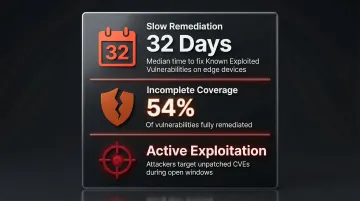
- Slow remediation timelines: The Verizon 2025 DBIR found the median time to fix Known Exploited Vulnerabilities on edge devices was 32 days
- Incomplete coverage: Only 54% of vulnerabilities were fully remediated during the study period
- Active exploitation: Attackers specifically target unpatched critical infrastructure with known CVEs while that window remains open
Critical System Monitoring Best Practices
Establish a Continuous Monitoring Strategy
Monitoring must be continuous and automated—not periodic or manual. It needs to cover system health, user activity, network traffic, configuration states, and security events in real time.
Reactive monitoring that only alerts after a breach isn't enough for critical assets. Organizations need ongoing awareness that catches active compromise as it's happening, not after damage is done.
NIST SP 800-137 emphasizes maintaining ongoing awareness of information security, vulnerabilities, and threats to support organizational risk management decisions. This means integrating vulnerability scanning, performance data, network monitoring, and system audit logs through centralized platforms that correlate signals across multiple layers.
Implement File Integrity Monitoring (FIM)
File Integrity Monitoring tracks changes to critical system files, directories, registries, and configurations in real time. Even small unauthorized modifications to a critical system can indicate active compromise or dangerous misconfiguration. PCI DSS v4.0.1 Requirement 11.5.2 mandates FIM deployment to alert about unauthorized modifications and perform critical file comparisons at least weekly.
What to baseline and monitor:
- System binaries and executables
- Configuration files for applications and services
- Registry keys (Windows environments)
- Critical directories containing sensitive data
- User account databases and authentication files
FIM provides an essential integrity signal that should feed into your SIEM for correlation with other security data. This enables faster detection of multi-stage attacks that modify system files as part of persistence or privilege escalation.
Centralize Logs and Integrate with a SIEM
Centralized log management consolidates data from all critical systems—servers, endpoints, network devices, and cloud resources—into a SIEM or unified log platform. This correlation enables detection of multi-vector attacks that span several systems, revealing patterns that manual log review would miss entirely.
Key log sources to consolidate:
- Authentication and IAM systems
- File integrity and configuration change logs
- Network traffic and DNS logs
- Cloud provider activity logs
- Endpoint detection and response (EDR) data
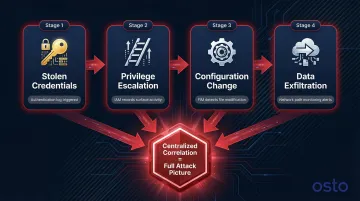
Consider a typical attack chain: stolen credentials trigger an authentication log, privilege escalation surfaces in IAM records, a configuration change appears in FIM, and data leaves through a monitored network path. No single log shows the full picture — centralized correlation does.
The 2024 IBM Cost of a Data Breach report found that organizations with tested incident response plans and extensive AI and automation saw significantly lower breach costs. Integrated detection platforms are a core reason why.
Monitor Cloud Posture and Resource Configurations
Misconfigurations, over-permissioned roles, exposed storage buckets, and policy drift are among the most exploited entry points in cloud environments. For businesses running workloads on AWS, Azure, or GCP, cloud posture monitoring is no longer optional — it's a baseline requirement.
Automated discovery with enriched metadata closes the gaps that manual audits consistently miss. Osto's Cloud Security Posture Management delivers unified multi-cloud visibility across Azure, AWS, and GCP in a single consolidated inventory, with automated periodic discovery of 35+ resource types per provider. The platform collects configuration, networking, identity, and encryption metadata, and runs built-in security checks that automatically generate findings for misconfigurations, exposure risks, and security-critical issues.
Set Up Threshold-Based Alerting and Audit Logs
Configure meaningful alerts based on thresholds for high-risk behaviors:
- Multiple failed login attempts within short timeframes
- Unusual data transfer volumes or destinations
- Privilege escalations or role changes
- Access attempts during off-hours or from unusual locations
- Configuration changes to critical systems
Avoid alert fatigue by tuning thresholds to your environment's baseline and focusing on behaviors that indicate active compromise. Maintain tamper-proof audit logs that capture all administrative activities and authentication events—these logs provide forensic investigation capability and compliance evidence. Osto's Audit Logs feature, introduced in October 2025, provides enhanced tracking of all administrative changes and authentication activities with improved transparency for compliance oversight.
Security Best Practices for Critical Systems
Enforce the Principle of Least Privilege
Every user, process, and application should have only the minimum access needed to perform its function. This limits blast radius when compromise occurs—a concern that's especially acute for admin accounts with full system control.
Practical implementation steps:
- Deploy role-based access control (RBAC) with clearly defined roles
- Conduct regular access reviews to identify and remove excessive permissions
- Remove dormant accounts and orphaned credentials
- Assign users to groups and apply policies granting minimum necessary access
- Regularly audit privileged account usage
Osto's Admin Management feature enables Super Admins to add multiple administrators and assign tailored permissions for better control and governance, supporting granular least-privilege enforcement across the platform.
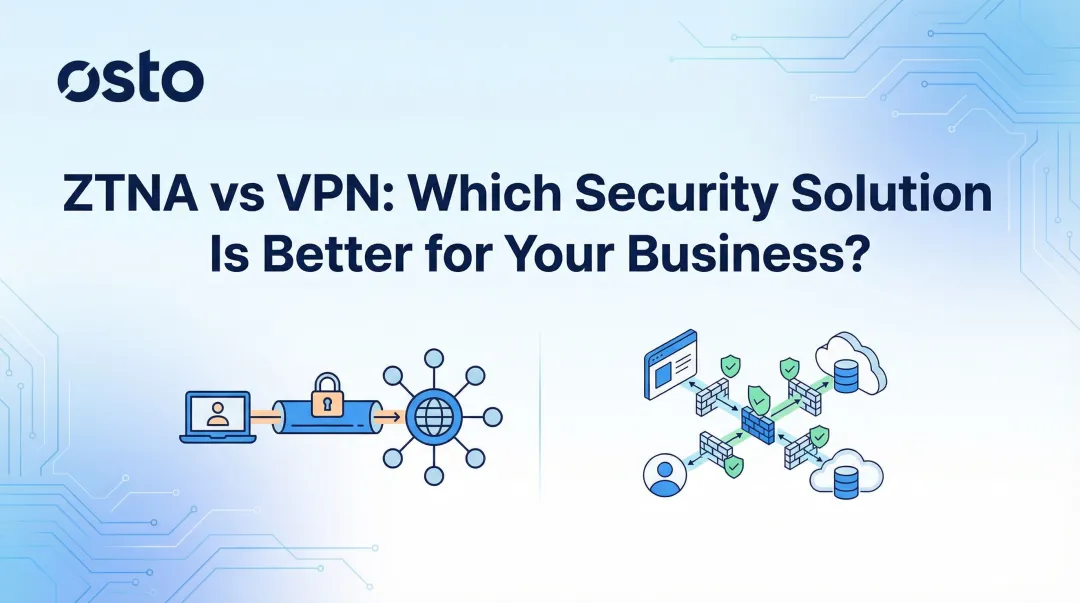
Implement Zero Trust Network Access (ZTNA)
Zero Trust operates on the principle "never trust, always verify"—regardless of whether a user is inside or outside the network perimeter. ZTNA ensures that remote workers, contractors, and third parties only access the specific critical resources they're authorized for, using continuous authentication and session monitoring.
Key ZTNA components:
- Multi-factor authentication (MFA) for all access to critical systems
- Micro-segmentation that isolates critical resources
- Continuous session validation and monitoring
- Time-bound access with automatic expiration
- Device posture verification before granting access
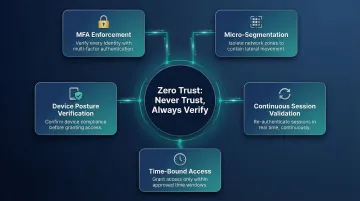
Osto's Zero Trust Network Access capability provides secure remote work with MFA enforcement for Secure Server and Secure Gateway connections. Each server-user combination gets unique access credentials, with access log monitoring running continuously for anomaly detection.
Harden Systems and Control Applications
System hardening reduces attack surface by eliminating unnecessary entry points — disabling unused services, closing open ports, applying secure configurations, and removing default credentials that attackers routinely exploit.
Application control takes this further: whitelisting approved processes and blocking unauthorized executables provides proactive defense, stopping malware execution even if it reaches the system. Osto's Application Filtering capability lets organizations block or allow specific applications on user devices, enforcing software policies before unauthorized tools ever run.
Hardening checklist:
- Disable unnecessary services and protocols
- Close unused network ports
- Remove default accounts and credentials
- Apply secure baseline configurations (CIS Benchmarks)
- Implement application whitelisting
- Enable host-based firewalls
Conduct Vulnerability Scanning and Timely Patch Management
The Verizon 2025 DBIR found that median remediation time for critical vulnerabilities was 32 days — which means scanning frequency and patch velocity directly determine your exposure window.
Osto's AI-powered Web Vulnerability Scanner runs on configurable schedules, delivering 2x faster scan execution with improved detection accuracy. The platform categorizes findings by severity and provides step-by-step remediation guidance, so teams address critical exposures first rather than working through a flat queue.
Patching critical systems presents real challenges — uptime constraints, compatibility requirements, and change management overhead. Practical strategies include:
- Staged rollouts with testing in non-production environments
- Compensating controls when patching must be delayed
- Prioritizing CVEs by exploitability and impact
- Maintaining an inventory of unpatched systems with documented risk acceptance
Efficient patch management isn't about speed alone — it's about balancing security urgency with operational stability through repeatable, documented processes.
Develop and Test an Incident Response Plan
Prevention reduces risk; it doesn't eliminate it. An effective incident response plan for critical systems includes defined escalation paths, isolation procedures, recovery playbooks, and communication protocols. The 2024 IBM report found that organizations with IR teams and robust security testing reduced breach costs by $248,000 on average—demonstrating the financial value of preparation.
Essential IR plan components:
- Clear roles and responsibilities
- Documented escalation procedures
- System isolation and containment steps
- Communication templates for stakeholders
- Recovery procedures and backup validation
- Post-incident review process
Run tabletop exercises at least quarterly and full drills annually. A plan that's never been tested will have gaps you only discover mid-incident — when the cost of discovery is highest.
Building a Resilient Critical System Protection Framework
Start with Asset Classification
Organizations must identify and rank their critical systems by business impact—not all assets need the same level of protection. A tiered classification model helps allocate security resources proportionally, ensuring the most business-critical assets receive the most rigorous controls.
Classification criteria:
- Operational impact if the system goes offline
- Data sensitivity and regulatory exposure
- Compliance obligations tied to the asset
- Direct revenue risk from a breach or outage
- Recovery time objectives (RTO)
This risk-based approach allows smaller teams to focus limited resources where they matter most, instead of spreading protection uniformly across all assets.
Adopt Unified Security Tooling
Fragmented point solutions create visibility gaps and slow response times. The 2024 Ponemon Institute report found that organizations use an average of 54 separate cybersecurity technologies, with 40% believing they have too many tools to maintain a strong security posture.
That fragmentation hits growing businesses hardest—teams without large IT departments can't absorb the overhead of managing dozens of disconnected tools.
A centralized platform that combines web application protection, cloud security posture management, threat detection, and access control in one place reduces operational overhead while improving visibility. Osto provides this unified approach, bringing together:
- Web Application & API Protection with DDoS mitigation and OWASP Top 10 defense
- Cloud Security Posture Management across Azure, AWS, and GCP
- Zero Trust Network Access for secure remote work
- Endpoint protection with device and application control
- Vulnerability scanning with AI-powered detection
- Centralized monitoring through a single dashboard
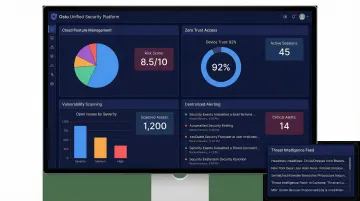
That consolidation matters beyond convenience. The 2024 IBM report found that security skills gaps contributed to a $1.76 million increase in average breach costs for organizations with severe staffing shortages. By automating routine tasks and surfacing alerts in one place, unified platforms help lean teams stay ahead without burning out.
Commit to Continuous Improvement
A protection framework is not a one-time setup—it requires ongoing attention. Conduct formal security audits at least annually, with continuous automated scanning running between reviews. Trigger additional assessments whenever significant infrastructure changes occur, including:
- Migrating to a new cloud provider
- Onboarding a new third-party integration
- Deploying new critical applications
Stay current with the threat landscape by monitoring advisories from CISA, vendor security bulletins, and industry-specific threat intelligence. Update policies as organizational roles change, new applications are introduced, and business requirements evolve. Osto's real-time posture evaluation and automated periodic discovery help organizations maintain current visibility as their infrastructure changes, so security posture keeps pace with the business rather than falling behind it.
Frequently Asked Questions
What is the meaning of critical system?
A critical system is any system whose failure, compromise, or unavailability would significantly disrupt an organization's core operations, safety, or services. The definition has expanded from industrial controls to include cloud workloads, web applications, databases, and authentication systems in modern businesses.
What is an example of a critical system?
Critical systems vary by context:
- Industrial: SCADA systems and power grid controls
- Enterprise: ERP platforms, payment processors, and customer databases
- Digital/cloud: Web applications, cloud infrastructure, and authentication systems
What is the best way to monitor critical systems for security threats?
Implement continuous automated monitoring covering real-time activity, file integrity, log aggregation, and cloud configuration states. Use centralized SIEM platforms to correlate events across systems, with alerting tuned to high-risk behaviors like privilege escalation, unauthorized configuration changes, and anomalous access patterns.
How do you protect critical systems from cyberattacks?
Effective protection requires layered controls working together:
- Least privilege access to limit blast radius if credentials are compromised
- Zero Trust networking to verify every access request
- System hardening to reduce attack surface
- Regular vulnerability scanning with timely patching
- Tested incident response plan for rapid recovery
What is the difference between intrusion detection and intrusion prevention in critical system security?
Intrusion detection (IDS) monitors and alerts on suspicious activity, while intrusion prevention (IPS) actively blocks or contains threats in real time. Modern critical system protection requires both: IDS for visibility into attack patterns and IPS for automated response to known threats.
How often should critical systems undergo security audits?
Conduct formal security audits at least annually, with continuous automated scanning between audits. Trigger additional reviews whenever significant infrastructure changes occur, such as cloud migrations, new third-party integrations, or major application deployments that alter your security posture.