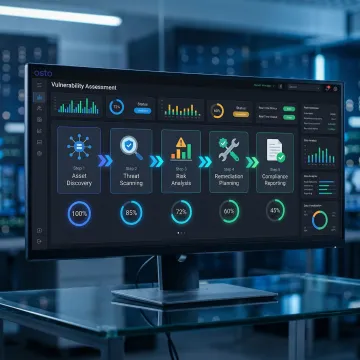
What is application vulnerability assessment?
Application vulnerability assessment is a systematic process of identifying, classifying, and prioritizing security weaknesses in software applications—including web apps, APIs, and mobile apps. It involves automated scanning, manual analysis, and validation of vulnerabilities against known threat databases like OWASP Top 10. The goal is to surface exploitable flaws before attackers do, providing development and security teams with clear, prioritized remediation guidance to reduce application risk.
How is vulnerability assessment different from penetration testing?
Vulnerability assessment identifies and catalogs all known weaknesses in an application without actively exploiting them—it answers 'what is vulnerable?' Penetration testing goes further by simulating real-world attacks to exploit those vulnerabilities and determine actual impact. Osto offers VAPT as a Service, combining both disciplines: automated vulnerability discovery followed by validated penetration testing to provide a complete picture of your application's exploitability and risk severity.
How often should application vulnerability assessments be conducted?
Best practice recommends running continuous or scheduled vulnerability scans for production applications—at minimum monthly, and after every significant code release or infrastructure change. Osto's AI scanner supports configurable scan schedules with automated reporting, ensuring vulnerabilities introduced by new features or configuration changes are detected quickly rather than accumulating over release cycles.
Which vulnerability types does Osto's assessment cover?
Osto covers a comprehensive range of application vulnerabilities including OWASP Top 10 threats (SQL injection, XSS, broken authentication, insecure deserialization, and more), API abuse and anomalies, DDoS exposure, SSL/TLS misconfigurations, cloud resource misconfigurations across AWS, Azure, and GCP, and endpoint security gaps. Each finding includes severity classification, affected endpoint details, and step-by-step remediation guidance.
What deliverables are included in an Osto vulnerability assessment?
Osto generates detailed scan reports showing exact vulnerability locations, affected endpoints, severity classifications, and step-by-step fix instructions. Reports are delivered via scheduled email with clean formatting for readability. The dashboard provides an overall security score, severity breakdown, and remediation progress tracking, giving both technical teams and business stakeholders a clear view of the application's security posture.
Does Osto support vulnerability assessment for cloud-hosted applications?
Yes. Osto provides comprehensive cloud security posture management for applications hosted on AWS, Microsoft Azure, and Google Cloud Platform. The platform performs automated periodic discovery of 35+ resource types—including VMs, storage, databases, serverless functions, and Kubernetes clusters—and surfaces misconfigurations, exposure risks, and security-critical issues with built-in remediation guidance for each finding.
Is continuous monitoring available after the initial assessment?
Absolutely. Osto is designed for continuous security monitoring, not one-time assessments. The platform runs scheduled scans, monitors real-time traffic threats through its WAF and API protection modules, and continuously evaluates your cloud posture. Administrators receive automated reports on scan frequency schedules, and the dashboard tracks new findings and remediation progress over time to maintain a strong security baseline.
How does Osto help teams prioritize which vulnerabilities to fix first?
Osto's AI-powered scanner categorizes every discovered vulnerability by severity—critical, high, medium, and low—so teams immediately know where to focus remediation efforts. Critical issues that are most frequently targeted are surfaced first. Each finding includes precise location details and contextual risk information, enabling engineering teams to make informed prioritization decisions without needing to interpret raw scanner output independently.