What is IAM in Cybersecurity?
Identity and Access Management (IAM) is a cybersecurity framework of policies, processes, and technologies that manages digital identities and controls who can access which systems, applications, and data—and under what conditions. Put simply: IAM verifies who you are, then decides what you're allowed to do.
IAM operates through two foundational halves working in tandem:
- Identity Management establishes and verifies who a user is through digital profiles, authentication mechanisms, and lifecycle tracking
- Access Management determines what that verified user is allowed to do through permission frameworks, authorization rules, and policy enforcement
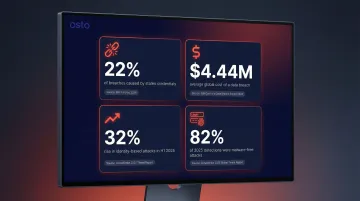
Together, these components form the backbone of modern access security. The numbers show how much is at stake: stolen credentials are the most common initial access vector, responsible for 22% of all data breaches, and the average breach now costs $4.44 million globally.
In the United States, that figure has climbed to a record $10.22 million per breach. Compromised identities sit at the center of most modern security incidents — which is why IAM has become a foundational control, not an afterthought.
Key Takeaways
- IAM controls who accesses your systems and what they can do once inside
- Combines identity management (verifying who you are) with access management (enforcing what you can do)
- Operates on four core pillars: Administration, Authentication, Authorization, and Auditing
- Key components include SSO, MFA, RBAC, PAM, and Identity Governance
- Foundational for compliance, remote work security, and preventing identity-driven attacks
How Does IAM Work? The 4 Core Pillars
IAM functions through a continuous cycle: it knows who is in the system, verifies them when they request access, decides what they're allowed to do, and monitors what they actually do. This cycle maps to four foundational pillars that every IAM system must address.
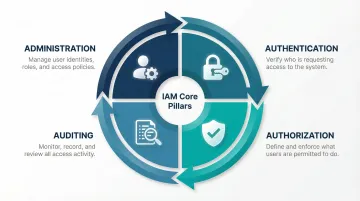
Administration (Identity Lifecycle Management)
Administration covers the creation, maintenance, and deprovisioning of digital identities (a unique profile for each human or non-human user, including employees, contractors, IoT devices, and AI agents). Digital identities are stored in a central directory and updated as roles change throughout the employee lifecycle.
Where deprovisioning breaks down: When employees leave, their accounts must be immediately disabled. Yet 73% of security teams still rely on manual ticket-based removal, leaving lingering access that attackers can exploit. Automated deprovisioning is essential to prevent orphaned accounts (active credentials tied to departed users or obsolete processes) that create hidden escalation paths.
Authentication
Authentication verifies that a user is who they claim to be. Basic password-only authentication is weak and easily compromised. Stronger methods include:
- Multi-Factor Authentication (MFA): Requires two or more verification factors (password + OTP token + biometrics)
- Single Sign-On (SSO): Authenticates once to access multiple applications
- Biometric verification: Fingerprint, facial recognition, or behavioral patterns
- Passwordless/passkey approaches: FIDO2 keys and device-based authentication
MFA alone reduces the risk of account compromise by 99.22% — which is why it's considered a baseline requirement in any modern IAM strategy.
Authorization
Authorization happens after authentication: it determines what a verified user is permitted to access or do. The most common framework is Role-Based Access Control (RBAC), where access is assigned based on job function rather than individual negotiation.
The guiding philosophy is the Principle of Least Privilege (PoLP): users get only the minimum access required for their role. This limits the blast radius if credentials are compromised.
Auditing
Auditing closes the loop by tracking and logging what users do with their access. Audit trails flag anomalous behavior: privilege escalation, unusual login times or locations, and unauthorized access attempts.
These logs are essential for:
- Incident response: Investigating security events and understanding attack paths
- Compliance demonstration: Meeting regulatory requirements like GDPR, HIPAA, and PCI DSS that mandate activity tracking
- Behavioral analysis: Identifying insider threats and compromised accounts through pattern recognition
Key Components of an IAM System
IAM systems are built from multiple integrated components, each handling a specific function. Organizations may use point solutions or unified IAM platforms that consolidate these capabilities.
Single Sign-On (SSO)
SSO lets users authenticate once and gain access to multiple applications without re-entering credentials. Benefits include:
- Reduced password fatigue and fewer weak or reused passwords
- Better user experience with seamless application access
- Centralized authentication control for IT teams
SSO uses federation protocols like SAML and OIDC behind the scenes to securely share authentication tokens across applications.
Multi-Factor Authentication (MFA)
MFA requires users to provide two or more verification factors:
- Something you know: Password or PIN
- Something you have: OTP token, authenticator app, or hardware key
- Something you are: Biometrics like fingerprint or facial recognition
Microsoft reports that MFA can block over 99.9% of account compromise attacks, making it the single most effective control for preventing unauthorized access.
Privileged Access Management (PAM)
PAM is a specialized IAM component for high-privilege accounts—system admins, IT managers, and service accounts with elevated access to critical systems. 74% of data breaches involve access to a privileged account, which is why these accounts draw the most attacker attention.
PAM tools use:
- Credential vaults: Securely store and rotate privileged passwords
- Just-in-time access: Grant elevated permissions only when needed, for limited durations
- Session monitoring: Record and analyze privileged user activity for anomalies
Role-Based Access Control (RBAC) and Identity Governance
RBAC assigns permissions based on job roles rather than per-user customization, making access policies scalable and consistent. Instead of granting individual permissions to each employee, organizations define roles like "Developer," "Marketing Manager," or "Finance Analyst" with pre-configured access levels.
Identity Governance sits above RBAC as the oversight layer — auditing who has access to what, flagging over-privileged accounts, and generating compliance reports. Modern Identity Governance and Administration (IGA) solutions automate access reviews, certifications, and policy enforcement.
Zero Trust and Federated Identity
Modern IAM is built around Zero Trust architecture, which operates on the principle of "never trust, always verify" — even for users already inside the network. Zero Trust assumes breach and continuously validates every access request based on identity, device posture, and context.
Federated identity takes this further by allowing organizations to share verified identities across systems. Common examples include:
- Logging into a third-party app using a Google or Microsoft account via SAML or OIDC
- Granting partner organizations access to internal tools without creating separate credentials
- Enabling single identity verification across cloud platforms like Azure, AWS, and GCP
This eliminates redundant credential management and enables seamless cross-platform authentication.
Why IAM Matters for Modern Businesses
The threat landscape has evolved dramatically. Organizations today manage more identities—human employees, contractors, IoT devices, AI agents—accessing resources from more locations across distributed environments. Non-human identities now outnumber human identities by 144 to 1, representing a 56% year-over-year increase.
Identity-based attacks are accelerating alongside this growth. Microsoft reported a 32% rise in identity-based attacks in the first half of 2025, driven by AI-assisted social engineering and scaled password spray campaigns. 82% of detections in 2025 were malware-free — attackers simply logged in with valid credentials instead of breaching defenses.
Remote Work and Cloud Acceleration
The traditional network perimeter no longer exists. With users accessing cloud applications from personal devices and home networks, identity becomes the new perimeter. Firewalls and VPNs alone cannot secure distributed workforces—IAM fills the gap by verifying identity and enforcing access policies regardless of location.
Compliance Requirements
Regulations such as GDPR, HIPAA, and PCI DSS require organizations to:
- Restrict access to sensitive data based on role and need
- Maintain audit logs of who accessed what and when
- Prove access controls during audits and breach investigations
IAM provides the controls and audit trails that make these requirements achievable — and provable when regulators come knocking.
IAM for Growing Businesses
Startups and scaling teams often grant access informally—everyone gets admin rights, former employees retain accounts, and Shadow IT proliferates. IAM disciplines and automates this process from the start.
Platforms like Osto—built for growing businesses—incorporate access control without requiring a large IT team. Osto's September 2025 release delivered admin management features that include:
- Super Admin controls for adding multiple admins with tailored permissions
- Role-based access aligned with RBAC principles
- MFA enforcement accessible to non-specialist users
Key Benefits of IAM
Security Benefits
- Reduced breach risk: Least-privilege access and MFA prevent unauthorized access
- Limited blast radius: If credentials are compromised, users can only access what their role permits
- Automated deprovisioning: Removes lingering access for departed employees, eliminating orphaned accounts
The numbers back this up: according to IBM's 2024 Cost of a Data Breach Report, organizations using AI and automation extensively lowered average breach costs by $1.9 million and cut containment times by 80 days.
Operational and Productivity Benefits
- SSO reduces friction: Fewer passwords to manage, less help desk burden
- Automated provisioning: Saves time during onboarding and offboarding
- Centralized visibility: IT teams gain a single view of who has access to what
The business case is measurable: a Forrester Total Economic Impact study found IAM automation delivers 211% ROI, driven by a 75% reduction in password reset requests and nearly $500,000 in reclaimed employee productivity.
Compliance and Business Trust Benefits
- Simplified regulatory reporting: Audit trails document access activity
- Consistent policy enforcement: Access rules are applied uniformly, not ad hoc
- Demonstrated due diligence: Organizations can prove security controls to customers, partners, and auditors
Implementing IAM: A Practical Guide for Growing Businesses
Foundational Steps
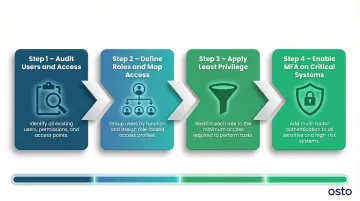
- Audit all current users, accounts, and access levels to understand what exists
- Define user roles and map access requirements to those roles
- Apply the Principle of Least Privilege—revoke any access that isn't tied to a clear business need
- Enable MFA across all critical systems as a baseline control
Common Implementation Pitfalls
Growing businesses run into the same IAM obstacles repeatedly. Here's what to watch for:
- Legacy tool gaps: Older systems often lack support for SAML or OIDC, requiring federation servers or custom connectors to bridge the gap.
- Shadow IT blind spots: Employees adopt apps without IT approval, creating unmonitored access points. App discovery audits and enforced SSO for sanctioned tools close this gap.
- Hybrid environment complexity: On-premises and cloud systems need directory synchronization (such as Active Directory synced to a cloud identity provider) to maintain consistent access control across both environments.
A phased rollout works better than a full cutover. Start with high-risk, high-privilege access, then expand to broader user populations once the foundation is stable.
Cloud-Based IAM and Identity-as-a-Service (IDaaS)
Cloud-based IAM solutions are particularly practical for startups and scaling businesses. These solutions are faster to deploy, require less infrastructure, and scale with the organization.
For growing businesses that want IAM-aligned controls without standing up a dedicated IAM stack, platforms like Osto include built-in admin role management, tailored permissions, and MFA capabilities as part of a broader security platform.
Osto's cloud-based SaaS architecture lets organizations deploy access control and admin management without on-premise infrastructure, with MFA enforced across all Secure Server and Secure Gateway connections.
Frequently Asked Questions
What is IAM in cybersecurity?
IAM (Identity and Access Management) is a cybersecurity framework that manages digital identities and controls user access to systems, applications, and data. The goal is simple: verified users get access to what they need, and nothing more.
Is IAM considered cybersecurity?
Yes, IAM is a foundational component of cybersecurity. It functions as both a management discipline and a security capability, but works best when complemented by dedicated security tools like threat detection and endpoint protection rather than functioning as a standalone security solution.
What are identity and access management services?
IAM services are tools and platforms that handle the administration, authentication, authorization, and auditing of digital identities. Common examples include SSO, MFA, PAM, identity governance, and cloud-based IDaaS solutions for managing access at scale.
What are the 4 pillars of IAM?
The four pillars are:
- Administration — managing the full identity lifecycle (provisioning, changes, deprovisioning)
- Authentication — verifying who a user is before granting access
- Authorization — controlling what a verified user is allowed to do
- Auditing — monitoring and logging access activity for compliance and review
What is the difference between IAM and SIEM?
IAM controls who can access what — it's preventive and access-focused. SIEM (Security Information and Event Management) collects and analyzes security event logs to detect threats in real time — it's detective and monitoring-focused. The two are complementary and work together in most enterprise security stacks.
What is an example of IAM?
When an employee joins a company and is automatically provisioned with access to specific tools based on their role (RBAC), must verify their identity using a password and phone-based OTP (MFA), and is logged out and deprovisioned when they leave — that complete lifecycle is IAM in practice.