Introduction
The cyber threat landscape in 2026 has reached unprecedented scale. Cloud adoption, hybrid work, and IoT proliferation have expanded the attack surface dramatically, creating an urgent need for robust network security solutions across businesses of all sizes. According to the 2025 Verizon Data Breach Investigations Report, vulnerability exploitation as an initial access vector grew by 34%, now accounting for 20% of breaches.
For startups and scaling enterprises, the challenge is particularly acute. These organizations face the same sophisticated threats as large enterprises, yet often lack dedicated IT teams or matching security budgets. Ransomware is present in 88% of SMB breaches, compared to just 39% for larger organizations — a gap that reflects how exposed smaller organizations remain.
Picking the wrong solution wastes budget and leaves critical gaps. Picking the right one can make the difference between a contained incident and a full breach.
This guide breaks down the key types of network security technologies, the top platforms and providers in 2026, and the specific criteria worth evaluating before you commit to a solution.
Key Takeaways
- Network security solutions protect networks, data, and users from unauthorized access using layered technologies
- Key solution types include NGFWs, WAFs, IPS, ZTNA, and CSPM
- Top 2026 platforms deliver AI-driven threat detection with unified management across multi-cloud environments
- Top providers include Osto, Check Point, Palo Alto Networks, Fortinet, and Zscaler—covering use cases from cloud-native ZTNA to enterprise firewall deployments
- When evaluating platforms, prioritize real-time threat prevention, scalability, and fit with your cloud and remote work setup
What Are Network Security Solutions? Types & Technologies Explained
Network security solutions are the combined set of tools, platforms, policies, and processes that protect an organization's network infrastructure from unauthorized access, cyberattacks, data breaches, and insider threats—covering both on-premises and cloud environments.
Modern network security operates on three foundational pillars:
- Protection — Proactive controls to prevent attacks before they reach critical systems
- Detection — Identifying threats and anomalous behavior in real time
- Response — Containing and remediating incidents quickly to minimize damage
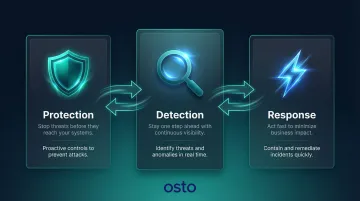
All three must work together. Protection without detection leaves you blind to sophisticated attacks. Detection without response means threats linger unchecked.
Firewalls and Next-Generation Firewalls (NGFW)
NGFWs go beyond traditional firewalls by operating at Layer 7 (application layer), enabling deep packet inspection (DPI), application awareness, and integrated IPS—making them a foundational perimeter control for modern networks.
Unlike legacy firewalls that simply block ports and protocols, NGFWs inspect the actual content and context of traffic, identifying threats hidden in legitimate-looking connections.
Web Application Firewalls (WAF)
WAFs specifically protect web applications by filtering and monitoring HTTP/HTTPS traffic to block attacks like SQL injection, XSS, and DDoS. For any business running customer-facing applications or APIs, WAFs provide direct defense against the OWASP Top 10 vulnerabilities—the most exploited web application attack vectors.
Zero Trust Network Access (ZTNA)
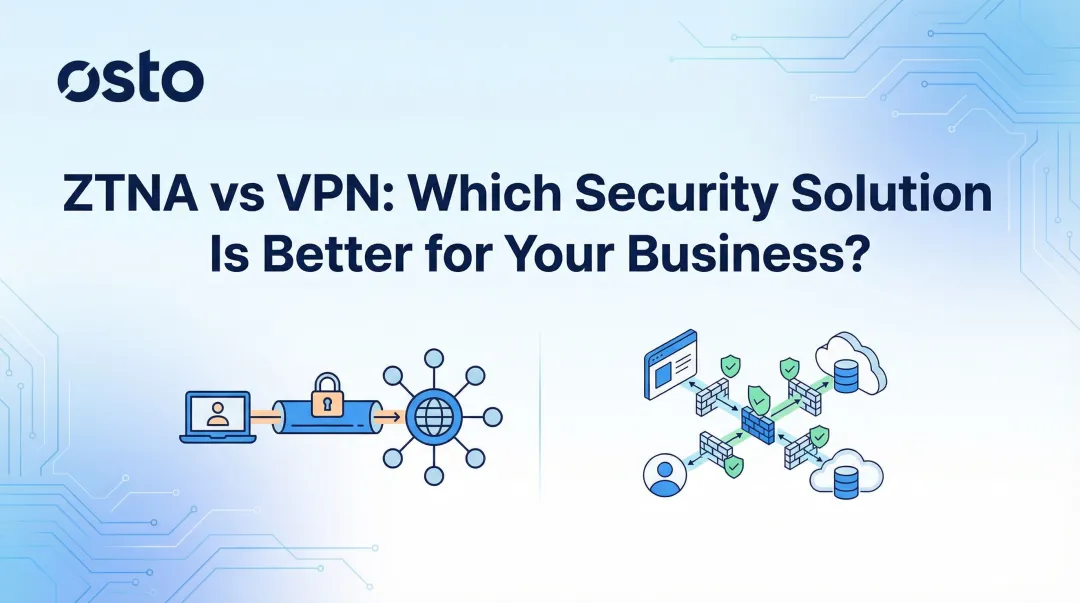
ZTNA is a security model that grants access on a "never trust, always verify" basis—continuously authenticating users and devices regardless of location. According to NIST SP 800-207, trust is never granted implicitly but must be continually evaluated. ZTNA replaces legacy VPNs with granular, application-level access controls, addressing a critical vulnerability: 56% of organizations suffered a VPN-related attack in the past year.
Intrusion Prevention Systems (IPS)
IPS monitors network traffic in real time, automatically blocking known attack signatures, exploit attempts, DoS attacks, and abnormal behaviors. It operates through three complementary approaches—signature-based, anomaly-based, and stateful inspection—filling detection gaps that firewall rules alone can't cover.
Cloud Security Posture Management (CSPM)
CSPM provides automated discovery, visibility, and risk assessment of cloud resources across providers like AWS, Azure, and GCP. It identifies misconfigurations and compliance gaps that traditional network tools miss. This is essential for multi-cloud businesses in 2026, as research shows that 70% of organizations face difficulties with cloud configuration and posture management security.
When evaluating providers, look for platforms that unify these capabilities—rather than managing five separate point solutions.
Best Network Security Solutions & Platforms in 2026
The platforms below were evaluated based on protection capabilities, breadth of coverage, suitability for growing businesses, ease of deployment, and real-world performance—not just brand name.
Osto
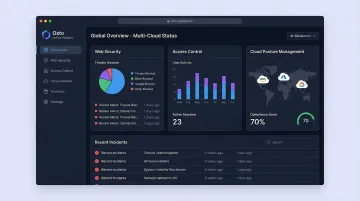
Osto is a cybersecurity platform built for startups, growing businesses, and scaling enterprises that need enterprise-grade protection without a large internal IT department. Its unified dashboard consolidates web security, access control, and cloud posture management in one place.
It combines AI-driven adaptive web protection profiling, an Nginx-based reverse-proxy WAF, ZTNA for secure remote access, and multi-cloud CSPM across Azure, AWS, and GCP—all from a single consolidated inventory with minimal setup overhead.
| Attribute | Details |
|---|---|
| Key Features | AI-powered WAF, ZTNA, multi-cloud CSPM (Azure/AWS/GCP), AI-driven vulnerability scanning, MFA, dual-layer SSL, Admin Management with audit logs |
| Best For | Startups, scaling enterprises, and businesses with multi-cloud infrastructure needing unified protection without complex setup |
| Deployment Model | Cloud-based; centralized dashboard with streamlined onboarding and low operational overhead |
Check Point
Check Point's Quantum Network Security platform has served enterprise clients globally for over 30 years, covering NGFW, SD-WAN, IoT security, remote access VPN, and AI-powered threat prevention.
Check Point's differentiator is its ThreatCloud AI, which updates in real time by analyzing millions of threat signatures daily. In independent testing by Miercom (2025), Check Point achieved a 99.9% block rate on new malware and 99.7% phishing prevention rate. Its single-console management provides operational advantage for mid-to-large enterprises.
| Attribute | Details |
|---|---|
| Key Features | NGFW, ThreatCloud AI, IPS, SD-WAN, remote access VPN, IoT security, policy management |
| Best For | Mid-to-large enterprises needing high-performance threat prevention with unified management |
| Deployment Model | On-premises, cloud, and hybrid; scalable up to 1 Tbps with load-balancing clusters |
Palo Alto Networks
Palo Alto Networks built its platform around eliminating fragmented security architectures. Its AI-powered stack (branded "Precision AI") covers NGFW, malware protection, DNS security, SD-WAN, and IoT security under one roof—founded in 2005 and now deployed across large enterprise environments globally.
Its key strength is consolidating many security functions into a unified platform with a focus on automation and proactive protection. However, its architecture splits across two platforms (network security and security operations), which adds management complexity for smaller teams. In CyberRatings 2025 Q4 testing, Palo Alto initially struggled with Layer 3 and Layer 4 evasions before a firmware update earned it a "Recommended" rating.
| Attribute | Details |
|---|---|
| Key Features | NGFW, Precision AI, DNS security, SD-WAN, IoT security, ZTNA, malware protection |
| Best For | Large enterprises prioritizing AI-driven automation and a consolidated security stack |
| Deployment Model | Cloud-delivered and on-premises; requires managing two separate platform consoles |
Fortinet
Fortinet's FortiGate NGFW is one of the most widely deployed firewalls in the world, combining threat protection, IPS, web filtering, sandboxing, and SD-WAN in a single appliance. Custom ASICs (SPUs) give it high-speed processing that software-only solutions typically can't match.
Fortinet's integrated Security Fabric ecosystem and competitive price-to-performance ratio make it attractive for organizations running their own hardware. A Forrester TEI study found 308% ROI and payback in less than six months. However, Fortinet's massive market footprint makes it a constant target—CISA's Known Exploited Vulnerabilities catalog frequently lists critical flaws requiring immediate patching.
| Attribute | Details |
|---|---|
| Key Features | FortiGate NGFW, Security Fabric, IPS, sandboxing, web/DNS filtering, SD-WAN, EDR, SIEM |
| Best For | Organizations seeking strong price-to-performance and an integrated hardware-software security stack |
| Deployment Model | On-premises hardware appliances, virtual machines, and cloud-native options |
Zscaler
Founded in 2007, Zscaler pioneered cloud-native security delivered as a service. Its two core products cover distinct needs: Zscaler Internet Access (ZIA) secures internet and cloud connections, while Zscaler Private Access (ZPA) provides zero-trust access to internal applications—both built for distributed workforces with no hardware required.
Zscaler's strength lies in its cloud-first architecture with no hardware to manage, making it ideal for remote-first and hybrid organizations. In CyberRatings 2025 Q2 SSE testing, Zscaler achieved 100% security effectiveness, successfully blocking 100% of 205 exploits, 6,184 malware samples, and 1,154 evasions—a flawless result enabled by unconstrained cloud compute for threat inspection.
| Attribute | Details |
|---|---|
| Key Features | ZTNA (ZPA), secure internet access (ZIA), AI-powered threat analysis, cloud-native SASE |
| Best For | Distributed and remote-first organizations needing cloud-native, hardware-free security |
| Deployment Model | 100% cloud-native; no on-premises hardware required |
How We Chose the Best Network Security Solutions
Evaluating network security solutions on feature lists or brand reputation alone leads to poor fit. The right solution must align with your actual threat landscape, infrastructure complexity, and team capacity — not just check specification boxes.
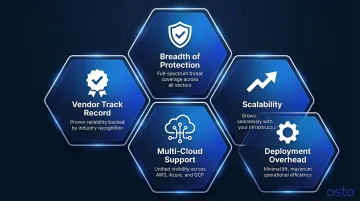
Our evaluation criteria included:
- Breadth of protection capabilities — Prevention, detection, and response across multiple attack vectors
- Scalability and flexibility — Solutions that grow with the organization without requiring complete replacement
- Deployment and management overhead — Platforms that don't require a large security team to operate effectively
- Multi-cloud and remote work support — Coverage for modern distributed infrastructure
- AI-driven threat detection — Automation that cuts manual triage and speeds incident response
- Vendor track record — Independent test results and real-world performance validation
Beyond these core criteria, we also weighted compliance and regulatory support — specifically audit logs and reporting for frameworks like GDPR and PCI DSS — alongside quality of customer support, which matters most for businesses without large internal security teams.
The stakes are real: organizations using unified platforms report that mean time to identify (MTTI) and mean time to contain (MTTC) security incidents are shorter by an average of 72 and 84 days, respectively, compared to those juggling an average of 83 separate security tools.
Conclusion
Network security in 2026 demands more than a single-point solution. Organizations need layered, integrated platforms that cover perimeter protection, application security, zero-trust access, and cloud posture in a unified way.
Before choosing a provider, assess where you actually stand:
- Infrastructure footprint — on-premises, cloud-native, or hybrid
- Team capacity — how much management overhead your team can realistically absorb
- Growth trajectory — whether the platform scales without requiring a full security ops rebuild
The right choice handles complexity on your behalf, not on your team's calendar.
For startups and scaling businesses, Osto consolidates WAF, ZTNA, AI-powered web scanning, and multi-cloud CSPM (Azure, AWS, and GCP) into a single platform — built to give growing teams full security coverage without the operational overhead of managing separate tools. Reach out at connect@osto.one to see how it fits your infrastructure.
Frequently Asked Questions
What are the network security solutions?
Network security solutions are the tools, platforms, and processes—firewalls, zero-trust access controls, cloud posture monitors, and similar defenses—that protect a network and its data from unauthorized access, cyberattacks, and breaches. Most modern deployments combine multiple solutions in a layered approach to address different threat vectors.
What are the three types of network security?
The three broad categories are physical security (protecting hardware from tampering or theft), technical security (tools that safeguard data in transit and at rest), and administrative security (policies governing user access and security practices). Most real-world programs address all three together.
What is ZTNA and how is it different from a VPN?
ZTNA grants granular, application-level access based on continuous verification of user and device identity, whereas a VPN grants broad network-level access once connected. This makes ZTNA far more secure for modern distributed and cloud-based environments.
How do I choose the right network security solution for my business?
Start by mapping your assets (cloud, on-premises, endpoints) and identifying your biggest risk areas. Then evaluate solutions on coverage, scalability, and ease of management—prioritizing platforms that fit your infrastructure and team size.
What is cloud security posture management (CSPM)?
CSPM automatically discovers and monitors cloud resources across AWS, Azure, and GCP, flagging misconfigurations, compliance violations, and security gaps in real time. It replaces manual auditing with continuous, automated visibility into your cloud security posture.