Introduction
Ransomware appeared in 44% of all analyzed breaches in 2025, and identity-based attacks now account for 30% of total intrusions. For startups and scaling companies with lean IT teams, the threat is clear — the harder problem is finding tools that hold up without requiring a dedicated security department.
The market doesn't make this easier. Gartner reports that large enterprises already manage an average of 45 distinct cybersecurity tools, creating operational drag and blind spots rather than better coverage. For growing businesses, the question isn't which tool is most powerful — it's which tools fit your team size, infrastructure, and risk profile without compounding the problem.
This guide evaluates the best cybersecurity software tools based on coverage breadth, ease of deployment, and suitability for businesses that need enterprise-grade protection without enterprise-scale IT departments.
Key Takeaways
- This guide covers the top cybersecurity platforms to protect endpoints, cloud infrastructure, and web apps — with picks for every team size
- Top picks balance threat detection accuracy, deployment simplicity, and scalability for lean teams
- Top platforms covered: Osto, CrowdStrike Falcon, SentinelOne Singularity, Palo Alto Networks, and Fortinet Security Fabric
- Evaluate tools on coverage breadth, AI detection quality, multi-cloud support, and total cost — not just sticker price
- Growing businesses get the most value from platforms that consolidate multiple security functions into a single dashboard
What Are Cybersecurity Software Tools?
Cybersecurity software tools are applications and platforms designed to protect digital assets—devices, applications, networks, cloud environments, and data—from threats such as malware, ransomware, phishing, and unauthorized access.
Modern cybersecurity tools span multiple categories:
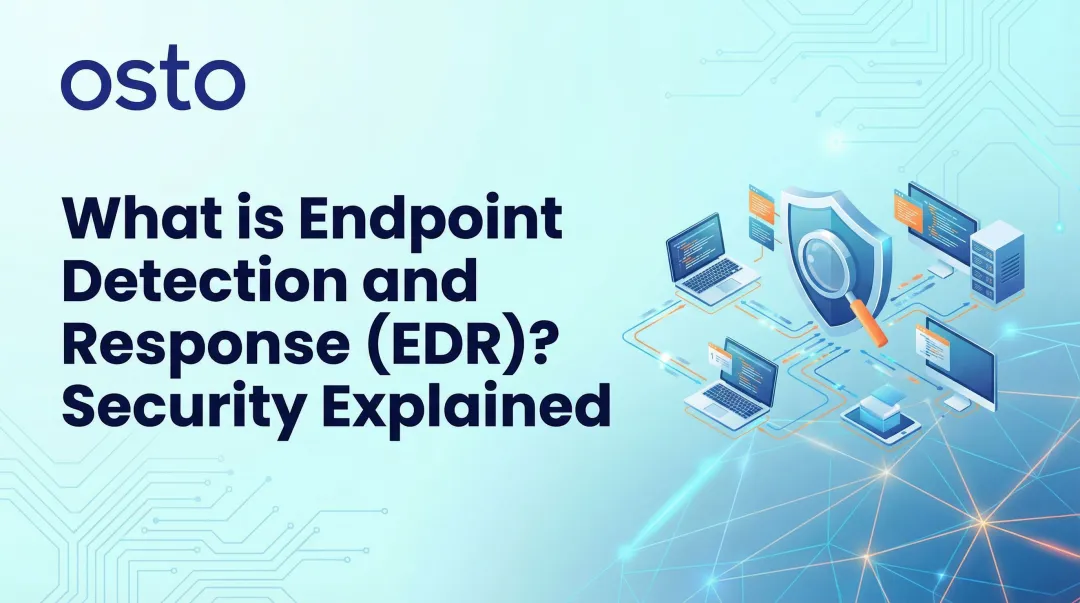
- Endpoint security (EDR/XDR) — Monitors and protects laptops, servers, and mobile devices
- Network security (firewalls, IDS/IPS) — Controls traffic flow and detects intrusions
- Cloud security (CSPM, WAF) — Identifies misconfigurations and protects web applications
- Identity and access management (IAM/ZTNA) — Enforces authentication and least-privilege access
- Vulnerability management — Scans for and prioritizes security weaknesses
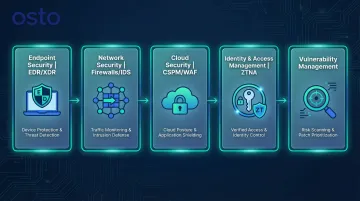
Each category addresses a different attack surface — which means most businesses end up juggling five or more separate tools. That fragmentation creates alert fatigue, integration headaches, and blind spots between layers. The strongest solutions on this list address multiple categories from one coordinated platform, cutting complexity without cutting coverage.
Best Cybersecurity Software Tools
The following tools were evaluated on threat detection accuracy, multi-environment coverage, ease of deployment without large IT teams, scalability, AI-powered capabilities, and value for growing businesses.
Osto
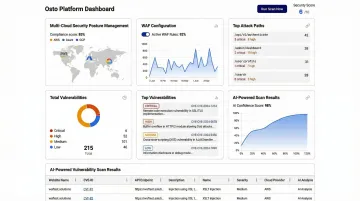
Osto is a cybersecurity platform built specifically for startups, growing businesses, and scaling enterprises that need enterprise-grade protection without a large IT department. Its core capabilities span web application protection, cloud security posture management across Azure, AWS, and GCP, Zero Trust Network Access, and AI-powered vulnerability scanning.
Where Osto stands out is consolidation: multiple security layers sit behind a single dashboard rather than spread across separate tools. Its Nginx-based reverse-proxy WAF provides dual-layer SSL encryption with automatic certificate management, while AI-driven adaptive web protection profiling monitors traffic patterns instead of relying on static rules alone.
The platform reached full multi-cloud coverage across Azure, AWS, and GCP in a short window — making it one of the few solutions offering posture visibility across all three major providers without a dedicated cloud security team. Its AI-powered scanner delivers 2x faster scan execution, automatically detecting OWASP Top 10 vulnerabilities including SQL injection and remote code execution.
| Feature Category | Details |
|---|---|
| Key Features | AI-powered web scanner, WAF with custom domain proxy, multi-cloud CSPM (Azure/AWS/GCP), ZTNA, audit logs, MFA, adaptive web protection profiling, automated cloud resource discovery (35+ resource types per provider) |
| Best For | Startups, growing businesses, and scaling enterprises needing comprehensive protection without a large IT team |
| Pricing Model | Contact connect@osto.one for pricing details tailored to your organization's size and requirements |
CrowdStrike Falcon
CrowdStrike Falcon delivers AI-powered endpoint detection and response (EDR) and extended detection and response (XDR) for organizations from mid-market to large enterprise, all through a single cloud-native architecture.
A single lightweight agent replaces the need for multiple endpoint tools — a real advantage for teams managing large device fleets. AI and behavioral analytics drive proactive threat hunting, catching threats before they escalate, while workflow automation cuts down on manual triage. The full stack covers endpoint protection, identity security, cloud workload security, and next-gen antivirus from one console. CrowdStrike has been named a Leader in the 2025 Gartner Magic Quadrant for Endpoint Protection Platforms for the sixth consecutive year.
| Feature Category | Details |
|---|---|
| Key Features | AI/ML-based threat detection, next-gen antivirus, identity protection, cloud workload security, threat hunting, USB device control, generative AI-powered workflow automation |
| Best For | Mid-to-large organizations prioritizing endpoint security, threat intelligence, and incident response |
| Pricing Model | SMB bundles: Falcon Go ($59.99/device annually), Falcon Pro ($99.99/device annually), Falcon Enterprise ($184.99/device annually); Falcon Complete and enterprise deployments are quote-based |
SentinelOne Singularity
SentinelOne Singularity is an AI-native XDR platform covering endpoints, cloud workloads, identities, and networks. It has earned recognition as a Gartner Magic Quadrant Leader for endpoint protection for five consecutive years.
Purple AI — SentinelOne's generative AI security analyst — translates natural language queries into structured searches and summarizes event logs, cutting investigation time for analysts who don't have hours to dig through raw telemetry. Hyper-automation handles incident response steps that would otherwise require manual effort.
The CNAPP layer covers CSPM, CWPP, CIEM, and CDR in one package, while the Singularity Data Lake ingests and normalizes telemetry across the environment — giving analysts a full incident narrative instead of fragmented alerts.
| Feature Category | Details |
|---|---|
| Key Features | XDR, AI-SIEM, CSPM/CWPP/CDR (CNAPP), endpoint protection, identity security, network discovery, Purple AI assistant, vulnerability management |
| Best For | Enterprises and security-mature organizations looking for an AI-native, fully integrated XDR and cloud security platform |
| Pricing Model | Per-endpoint annual pricing: Core ($69.99), Control ($79.99), Complete ($179.99), Commercial ($229.99); Singularity Enterprise is quote-based |
Palo Alto Networks
Palo Alto Networks spans network security, cloud security (Prisma Cloud), and AI-driven security operations through its Cortex platform — one of the broadest portfolios in the industry, built around three integrated product lines.
Precision AI runs across the entire product suite — machine learning and deep learning automate threat detection rather than relying on analyst-driven rules. The NGFW line enforces Zero Trust at the network perimeter, while Prisma Cloud handles CNAPP coverage across multi-cloud environments.
The three product pillars — Strata (network security), Prisma (cloud security and SASE), and Cortex (XDR and SOC operations) — are designed to share data and policy context rather than operate in silos. Palo Alto was recognized as a Leader in the Forrester Wave for Enterprise Firewall Solutions (Q4 2024) and the inaugural 2025 Gartner Magic Quadrant for Hybrid Mesh Firewall.
| Feature Category | Details |
|---|---|
| Key Features | NGFW with AI and Zero Trust, Prisma Cloud (CNAPP), Cortex XDR, URL/DNS filtering, DLP, WAF/API security, AI security posture management, advanced threat intelligence |
| Best For | Enterprises with complex multi-cloud and hybrid network environments requiring deep integration across network, cloud, and SOC security |
| Pricing Model | Custom, quote-based licensing across Strata, Prisma, and Cortex product lines, typically procured through channel partners |
Fortinet Security Fabric
Fortinet's Security Fabric architecture ties together network security (NGFW), SASE, and web application firewall (FortiWeb) under a single operating system — FortiOS. The platform serves enterprises, government, and SMBs across multiple industries.
Running everything through FortiOS means NGFW, SASE (with ZTNA and cloud firewall), SIEM, SOAR, EDR, CNAPP, WAF, and SD-WAN share the same policy framework — reducing integration overhead that typically comes with multi-vendor environments. FortiGuard Labs feeds real-time threat intelligence from millions of global sensors into the platform, delivering outbreak alerts as threats emerge.
FortiDLP handles insider risk and data loss prevention, while flexible licensing accommodates hybrid infrastructure without forcing a full architecture rebuild. Fortinet earned Leader recognition in both the 2025 Gartner Magic Quadrant for Hybrid Mesh Firewall and the 2025 Gartner Magic Quadrant for SASE Platforms.
| Feature Category | Details |
|---|---|
| Key Features | NGFW, SASE with ZTNA, WAF (FortiWeb), SD-WAN, SIEM/SOAR, EDR/XDR, CNAPP, DLP (FortiDLP), FortiGuard threat intelligence, SOCaaS |
| Best For | Organizations of all sizes needing broad, integrated network and cloud security coverage within a single vendor ecosystem |
| Pricing Model | Quote-based enterprise pricing through channel partners, with flexible licensing for hybrid infrastructure |
How We Chose the Best Cybersecurity Tools
Common mistakes buyers make include choosing tools based solely on brand recognition, overbuying features they won't use, underestimating total cost of ownership (including deployment and staffing), and selecting tools that require heavy customization to work effectively. The tools on this list were selected through a more deliberate focus on real-world fit.
Core selection criteria:
- Coverage breadth and depth — Protection across key threat surfaces (endpoints, network, cloud, web applications, identity) without requiring multiple disconnected tools
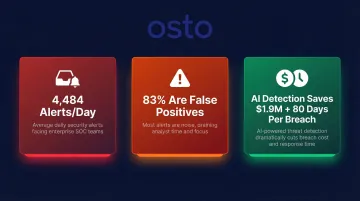
- AI and automation capabilities — Organizations that use AI-driven detection identify and contain breaches 80 days faster, saving an average of $1.9 million
- Scalability and ease of deployment — platforms that work without large dedicated security teams, eliminating the overhead of managing 45 separate tools
- Multi-cloud support — consolidation alone reduces related cybersecurity spend by up to 60% as cloud becomes the default environment
- Transparent pricing and TCO — Understanding true costs for businesses at different growth stages
Consolidating multiple security functions into one platform matters especially when your team is small. Running five separate point solutions multiplies both cost and complexity.
SOC teams already receive an average of 4,484 alerts daily — 67% go unhandled, and 83% turn out to be false positives. Unified platforms with AI-driven correlation cut through that noise, making security workable for lean teams.
Conclusion
Choosing the right cybersecurity software is less about picking the most well-known brand and more about finding a solution that aligns with your business's current infrastructure, team size, risk profile, and growth plans. A tool your team can't operate effectively offers less protection than a simpler one they use consistently.
With the global average cost of a data breach reaching $4.44 million and 32% of breached organizations paying regulatory fines, the cost of inadequate security far exceeds the investment in a proper platform.
When evaluating any tool, look beyond the initial feature list or licensing cost:
- Scalability — does it grow with your business without a full platform migration?
- Integration — how cleanly does it fit into your existing workflows and cloud environment?
- Ongoing cost — what does it actually cost to run as your team and infrastructure expand?
For growing businesses and startups looking for a unified platform that combines web application protection, multi-cloud security posture management, ZTNA, and AI-powered threat detection without requiring a large IT team, Osto brings all of that into a single, manageable platform. Reach out at connect@osto.one to learn more.
Frequently Asked Questions
What is the best cybersecurity software?
The best cybersecurity software depends on your specific needs. Endpoint-heavy organizations may prioritize CrowdStrike or SentinelOne, while growing businesses needing all-in-one web, cloud, and network protection may benefit more from platforms like Osto. The right fit depends on your team size, infrastructure, and risk profile.
What are the 7 types of cyber security?
The seven key domains are network security, cloud security, endpoint security, application security, identity and access management, data security, and operational security (or incident response). Modern platforms increasingly cover multiple domains within a single solution, consolidating coverage into fewer tools.
What are the signs of a malware infection?
Common indicators include unexplained system slowdowns, unusual network traffic, unexpected pop-ups or application crashes, disabled security software, and unknown processes running in the background. Cybersecurity tools with real-time monitoring can flag these behaviors automatically before they escalate.
How do I choose the right cybersecurity tool for my business?
Start by mapping your primary attack surfaces — endpoints, cloud, web apps, network — then evaluate tools on coverage, ease of deployment, scalability, and total cost of ownership. For smaller teams, consolidated platforms are worth prioritizing; managing multiple point solutions creates gaps and adds operational overhead.
Can small or growing businesses afford enterprise-grade cybersecurity tools?
Yes. Many modern platforms — including Osto — are built for growing businesses and offer scalable pricing. The cost of a breach (data loss, regulatory fines, reputational damage) almost always exceeds the cost of a proper security platform.
What is the difference between EDR, XDR, and SIEM?
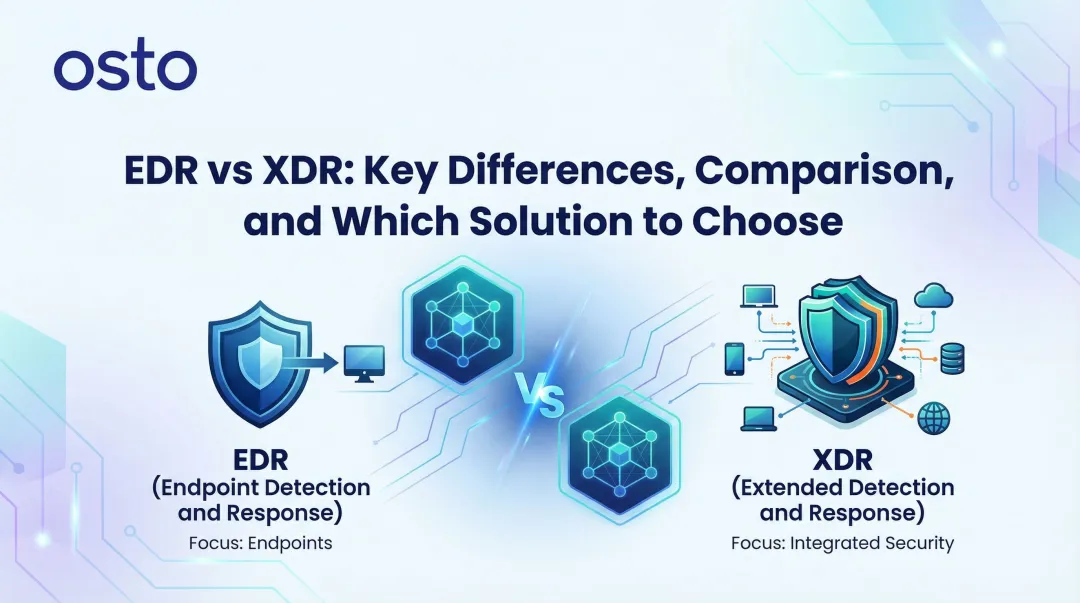
EDR (Endpoint Detection and Response) focuses on endpoint devices like laptops and servers. XDR (Extended Detection and Response) expands coverage across endpoints, networks, cloud, and identities for unified threat correlation. SIEM (Security Information and Event Management) aggregates and analyzes log data from across the environment for threat detection and compliance. Many modern platforms combine all three capabilities.