
Introduction
Growing businesses face a flood of cybersecurity acronyms (MSS, MSSP, MSP, MDR), and most decision-makers struggle to determine which model they actually need or how these services differ from each other.
The stakes are real: the global average cost of a data breach reached $4.44 million in 2025, while the cybersecurity workforce gap expanded to 4.76 million professionals. Without clarity on these service models, organizations risk paying for the wrong level of protection or leaving critical gaps exposed.
This article provides a plain-language breakdown of managed security services and the three most common provider models, with guidance on choosing the right fit for your organization's maturity, budget, and operational needs.
TLDR
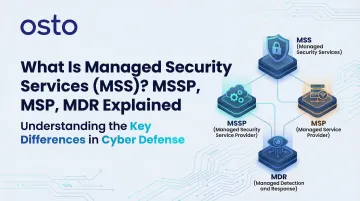
- Managed Security Services (MSS) is an umbrella term for any outsourced cybersecurity function handled by a third-party provider
- MSPs handle broad IT infrastructure; MSSPs specialize in 24/7 security monitoring; MDR goes further with threat hunting and active incident response
- No in-house SOC? MDR fits best. Existing security teams typically use MSSPs for supplemental monitoring coverage
- Startups often start with a platform like Osto — covering WAF, CSPM, and ZTNA in one place — before building a full in-house SOC
What Are Managed Security Services (MSS)?
Managed Security Services (MSS) is an umbrella term covering any cybersecurity service or solution delivered by a third-party provider. The scope ranges from narrowly focused services like firewall management or vulnerability scanning to comprehensive SOC-as-a-Service (SOCaaS) offerings that run an organization's entire security function.
Coverage varies widely depending on what a business needs:
- Light-touch services: Firewall log monitoring, quarterly vulnerability scans, compliance report generation
- Comprehensive SOC-as-a-Service: 24/7 threat monitoring, incident investigation, active response, and continuous threat hunting across all attack surfaces
MSS originated in the late 1990s when Internet Service Providers began managing firewall appliances for customers over dial-up connections. Today's market looks nothing like those early deployments — AI-powered detection, continuous threat hunting, and cloud-native delivery have reshaped what providers can offer.
According to MarketsandMarkets, the global MSS market is projected to grow from $39.47 billion in 2025 to $66.83 billion by 2030 — an 11.1% compound annual growth rate driven by escalating threats, regulatory demands, and the push for continuous monitoring.
Why Businesses Are Turning to Managed Security Services
The Cybersecurity Skills Gap
Organizations are turning to MSS providers because they simply cannot find or afford the talent required to run an internal SOC. The 2024 ISC2 Cybersecurity Workforce Study identified a global workforce gap of 4,763,963 professionals—a 19.1% increase from 2023. By 2025, the focus shifted from pure headcount to critical skills, with 59% of security teams reporting critical or significant skills gaps. Hiring, training, and retaining in-house security talent has become increasingly impractical for most organizations, making outsourced expertise a practical necessity for most teams.
The Cost of a Data Breach
The 2025 IBM Cost of a Data Breach Report places the global average cost at $4.44 million. Organizations that extensively use AI and automation in their security operations saved an average of $1.9 million compared to those that did not. For lean teams without dedicated security staff, a single breach can represent an existential threat to the business, making the subscription cost of MSS a prudent investment in risk mitigation.
The Expanding Attack Surface
Remote work, BYOD policies, and multi-cloud adoption have made the traditional network "perimeter" nearly impossible to define. The 2024 Verizon Data Breach Investigations Report notes that the human element is a component in 68% of breaches, and it takes organizations an average of 55 days to remediate 50% of critical vulnerabilities. In-house IT teams without security specialization cannot reliably close the gaps created by distributed workforces, shadow IT, and multi-cloud environments—creating opportunities that adversaries actively exploit.
Alert Fatigue and 24/7 Coverage Demands
Attackers don't keep business hours. Breaches regularly occur during off-hours, weekends, and holidays—making round-the-clock monitoring a baseline requirement, not a premium feature.
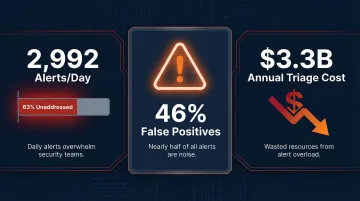
The volume alone is overwhelming. Organizations receive an average of 2,992 security alerts daily, yet 63% go unaddressed. Microsoft and Omdia research reveals that 46% of alerts are false positives, and 42% go entirely uninvestigated. The result: severe analyst burnout and an estimated $3.3 billion annually in manual triage costs for U.S. businesses—a burden MSS providers are built to absorb.
MSP vs. MSSP vs. MDR: What's the Difference?
These three terms are often used interchangeably but represent meaningfully different scopes of service and levels of engagement. Understanding the distinction is critical for vendor selection.
Managed Service Providers (MSP)
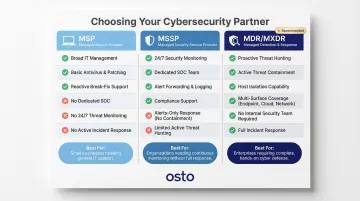
MSPs manage broad IT infrastructure—networks, applications, systems, and help desk support—with security being one component among many, not the primary focus. They are often reactive, responding when contacted rather than proactively monitoring for threats.
Typical MSP responsibilities include:
- General network management and system monitoring
- Basic antivirus deployment and patch management
- Backup and disaster recovery
- User support tickets and help desk
MSPs are a common starting point for small businesses, and many have expanded their portfolios to include basic security services by partnering with MSSPs or reselling security tools. They lack the dedicated SOCs and threat analysts that purpose-built security providers maintain.
Managed Security Service Providers (MSSP)
MSSPs are exclusively focused on cybersecurity, operating dedicated Security Operations Centers (SOCs) to provide 24/7 monitoring, threat alerting, vulnerability management, and compliance support. They manage security infrastructure including firewalls, intrusion detection systems, SIEM log aggregation, and compliance reporting.
Traditional MSSPs alert the customer's internal team when a threat is detected but do not actively investigate or contain the threat themselves. They forward high-volume alerts to the client's internal team for triage and validation, making them better suited to organizations that already have an in-house security function to act on those alerts. Forrester notes that many MSSPs have attempted to rebrand as MDR providers to escape the "alert factory" stigma, but fail to deliver true response capabilities.
Managed Detection and Response (MDR)
MDR is a proactive service combining technology with human security analysts who not only detect threats but also investigate, validate, and actively respond to contain them—without requiring the customer to act. Gartner defines MDR as delivering "remote mitigative response, investigation and containment activities (such as quarantining hosts), beyond alerting and notification."
MDR takes the response burden off the customer entirely. When a threat is detected, the provider actively disrupts and contains it—isolating compromised hosts, blocking malicious IPs, terminating suspicious processes—without waiting for internal approval. This makes MDR especially valuable for organizations that lack an internal SOC or dedicated security team.
MXDR (Managed Extended Detection and Response) extends MDR coverage across endpoints, cloud workloads, email, and network in a unified service. Where traditional MDR is often endpoint-heavy, MXDR unifies telemetry from multiple surfaces to detect complex, multi-stage attacks moving laterally across environments. For organizations with cloud infrastructure or distributed workforces, this broader coverage closes gaps that endpoint-only detection misses.
Key Capabilities Covered Under MSS
Core service categories an MSSP or MDR provider may cover include:
- Network & Perimeter Security: Managed firewalls, Intrusion Detection/Prevention Systems (IDS/IPS), VPN management, and Secure Access Service Edge (SASE) to protect organizational boundaries and secure remote access
- Security Monitoring (SOCaaS): 24/7 Security Information and Event Management (SIEM), log aggregation, and alert triage for continuous surveillance
- Vulnerability Management: Continuous vulnerability scanning, exposure assessment, and managed patching to reduce attack surface
- Threat Intelligence & Hunting: Proactive searching for hidden threats, integration of global threat feeds, and behavioral analytics to identify advanced persistent threats
- Compliance & Reporting: Audit trails, regulatory reporting templates, and data retention management for HIPAA, PCI DSS, and GDPR adherence
Not every provider covers all categories. Beyond scope, response depth is the other critical dimension to evaluate. Ask any prospective provider which of these three levels they operate at:
- Alerts only: Provider detects and notifies; your team investigates and responds
- Investigation and triage: Provider validates threats and provides remediation guidance; your team executes containment
- Full containment: Provider takes direct action without waiting for approval, with minimal internal workload required
Each level represents trade-offs in access permissions, privacy exposure, and internal workload. Organizations must explicitly define which level they need and verify that SLAs grant the provider appropriate containment authority.
Two subcategories worth tracking: managed cloud security and managed identity protection. As workloads shift to multi-cloud environments and identity-based attacks grow more common, Identity Threat Detection and Response (ITDR) has become a standard consideration. ITDR monitors authentication systems and enforces zero-trust architectures to address credential theft and account compromise.
How to Choose the Right MSS Model for Your Business
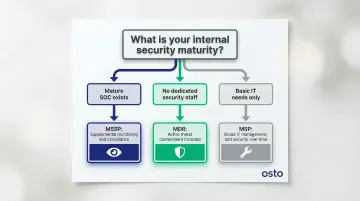
The decision centers on two key variables: internal security maturity (do you have an in-house SOC or dedicated security staff?) and the level of response you need from an outside partner (alerts only vs. full containment).
Practical decision guide:
- Organizations with a mature internal SOC that need supplemental coverage → Consider MSSP for additional monitoring, alerting, and compliance support
- Organizations without dedicated security staff or SOC → MDR is typically the better fit, providing active threat containment without requiring internal response capability
- Organizations needing broad IT management plus basic security → MSP may be sufficient initially, with MSSP capabilities added over time as security needs mature
Key Evaluation Criteria
When evaluating providers, assess:
- 24/7 availability: Verify the provider operates a true 24/7/365 SOC with human analysts, not just automated alerting
- Certifications and compliance expertise: Require SOC 2 Type II, ISO 27001, and frameworks relevant to your industry (GDPR, HIPAA, PCI DSS)
- SLA terms for response times: Demand explicit timelines for alert investigation and containment execution—not just uptime guarantees
- System access requirements: Understand how deeply the provider needs access to your systems, what data they will collect, and where the provider stores that data
Platform-Based Security as a Foundation
For startups and scaling businesses evaluating MSS options, a unified cybersecurity platform can establish the security controls and visibility you need—whether as a starting point before engaging an MSSP or MDR provider, or as a complement to one.
Osto is built for this use case. Core capabilities include:
- Web application protection: Nginx-based reverse-proxy blocks OWASP Top 10 vulnerabilities, DDoS attacks, and malicious bots before they reach your servers
- Multi-cloud posture management: Unified visibility across Azure, AWS, and GCP with automated discovery of 35+ resource types and step-by-step remediation for misconfigurations
- AI-driven vulnerability scanning: 2x faster scan execution with severity-based categorization and precise location details
- Zero Trust Network Access (ZTNA): Enforces authentication workflows and access controls for remote workforces
- Centralized dashboard: Consolidates monitoring across all security functions in one place
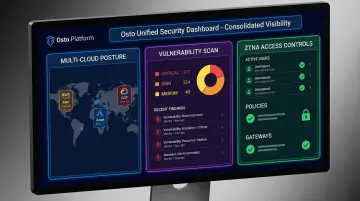
This platform approach allows organizations to establish foundational security controls, gain visibility into their attack surface, and implement automated protections while they evaluate whether and when to engage an MSSP or MDR provider for supplemental monitoring and response services.
Frequently Asked Questions
What are managed security services?
Managed security services are outsourced cybersecurity functions delivered by a third-party provider, covering everything from monitoring and threat detection to full incident response. They're designed to extend an organization's security capabilities without full in-house staffing.
What is the difference between an MSSP and a SOC?
An MSSP is an external vendor organization that offers managed security services to clients, while a SOC (Security Operations Center) is the physical or virtual team and infrastructure—either in-house or operated by the MSSP—that performs the actual monitoring and response work.
What is the difference between an MSP and an MSSP?
MSPs manage broad IT infrastructure and operations with security as one component, while MSSPs focus exclusively on cybersecurity with dedicated SOCs, 24/7 threat monitoring, and specialized security expertise. MSSPs provide deeper security capabilities than general IT service providers.
Is MDR better than MSSP?
MDR suits organizations without an internal security team — it includes active response and direct threat containment. MSSP fits organizations with an existing SOC that need supplemental monitoring and alerting but can handle response internally.
What services do managed security service providers typically offer?
MSSPs typically offer firewall management, intrusion detection, vulnerability scanning, security event monitoring, and compliance reporting. MDR providers extend these services to include active threat hunting, incident investigation, and direct containment actions like host isolation and account suspension.
How much do managed security services cost?
Pricing varies based on service scope, endpoints, and response level. According to 2024 MDR pricing benchmarks, endpoint-only MDR runs $48,000–$210,000 annually for 500 endpoints ($8–$35/endpoint/month); adding multi-surface coverage (cloud, identity, network) typically doubles that to $96,000–$420,000+. Both options generally cost less than staffing an equivalent in-house SOC.