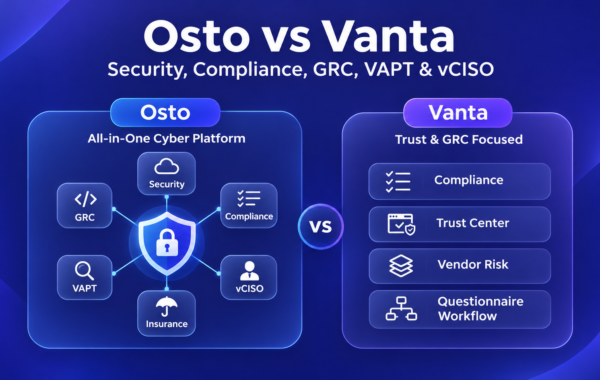
Osto brings security, compliance, GRC automation, VAPT, vCISO support and cyber insurance access into one platform for growing teams. Drata takes a different approach, with deeper focus on continuous compliance, enterprise GRC, third-party risk, Trust Center workflows and AI-assisted questionnaires. For teams comparing Osto vs Drata, the real decision is whether they want a dedicated trust and GRC layer or a broader cyber operating layer that also includes live security controls and testing.
Osto vs Drata: the short answer
Choose Osto when you want security, compliance, GRC automation, VAPT and cyber support in one platform.
Choose Drata when your primary need is continuous compliance, enterprise GRC, third-party risk and trust management.
Both can support audit readiness. The difference is how much of the actual cyber stack you want inside the same operating layer.
What problem are you actually trying to solve?
| Buyer question | What it points toward |
|---|---|
| Do we want one platform for security, compliance, GRC automation, VAPT and vCISO support? | Osto is designed around that broader all-in-one cyber model. |
| Is our main requirement continuous compliance, enterprise GRC and audit readiness? | Drata is strongly aligned to that use case. |
| Do we need live security across cloud, apps/APIs, endpoints, network/access and code? | Osto covers those security layers alongside compliance and GRC workflows. |
| Do we need mature third-party risk assessments and vendor monitoring? | Drata has dedicated TPRM workflows, automated assessments and vendor-risk tracking. |
| Do we need VAPT, vCISO support or cyber insurance access as part of the same cyber program? | Those are part of Osto’s broader offering. |
Osto vs Drata: three buying scenarios
1. Startup wants one cyber platform
If the same team needs security, compliance automation, GRC automation, VAPT, vCISO support and customer-assurance workflows, Osto can bring more of that program into one operating layer.
2. Team is primarily GRC-led
If the immediate priority is continuous compliance, risk, third-party risk, audit workflows, Trust Center and questionnaires, Drata is strongly aligned to that job.
3. Team already uses Drata
Osto does not necessarily need to replace Drata. A company can keep Drata for GRC and trust workflows while using Osto for broader security, VAPT, vCISO support and other cyber operations.
What you may still need around each platform
This is usually more useful than comparing framework lists.
If you choose Osto
Osto is designed to cover more of the cyber program in one place: security, compliance automation, GRC automation, VAPT, security questionnaires, vCISO support and cyber insurance access. Its strength is consolidation for teams that do not want to manage separate vendors for every part of their cyber program. Drata may still be relevant when a company wants particularly deep enterprise GRC, third-party risk, Trust Center or dedicated trust-management workflows.
If you choose Drata
Drata is strong in continuous compliance, enterprise GRC, third-party risk, Trust Center and AI questionnaire workflows. If your program also requires live web/API protection, endpoint security, code security, CSPM, VAPT, vCISO support or cyber insurance access, those are additional requirements to plan for because they are not the centre of Drata’s platform positioning.
Osto vs Drata comparison: 7 essential decision criteria
| Criteria | Osto | Drata |
|---|---|---|
| Primary role | All-in-one cyber platform covering security, compliance, GRC automation, VAPT, vCISO support and cyber insurance access. | Trust management and GRC platform focused on continuous compliance, risk and customer assurance. |
| Compliance and GRC automation | Yes. Osto supports control mapping, evidence, policies, questionnaires, monitoring and audit-readiness workflows alongside its wider cyber offering. | Yes. Continuous compliance, evidence collection, automated control monitoring and enterprise GRC are core Drata capabilities. |
| Security coverage | Cloud, web/API, endpoint, network/access and code security are part of the same platform. | Drata primarily monitors and validates controls through integrations rather than replacing the underlying security stack. |
| Third-party risk management | Not the central focus of Osto. | A major Drata strength, with vendor inventory, assessments, risk scoring, evidence collection and ongoing monitoring. |
| Security questionnaires and trust | Security-questionnaire workflows are available as part of Osto’s broader cyber platform. | Dedicated AI questionnaire assistance plus Trust Center workflows and reusable approved responses. |
| VAPT and vCISO | VAPT and vCISO support are available as part of Osto’s broader offering. | These are not core Drata platform functions. |
| Cyber insurance access | Available as part of Osto’s wider cyber offering. | Not a primary Drata platform function. |
Osto vs Drata: direct answers to common buyer questions
What is the main difference between Osto and Drata?
Osto is an all-in-one cyber platform combining security, compliance automation, GRC automation, VAPT, vCISO support, security questionnaires and cyber insurance access. Drata is more focused on continuous compliance, enterprise GRC, third-party risk, Trust Center and customer assurance.
Is Osto a Drata alternative for startups?
Yes, for teams looking for a broader Drata alternative for startups. Osto combines compliance and GRC automation with cloud, application/API, endpoint, network/access and code security, plus VAPT and vCISO support.
Which is better for security and compliance, Osto or Drata?
The answer depends on the operating model. Osto is designed for teams that want security and compliance in the same platform. Drata is designed more deeply around continuous compliance, GRC, trust and third-party risk workflows.
Does Osto provide GRC automation?
Yes. Osto supports GRC and compliance workflows including control mapping, evidence, policies, monitoring, questionnaires and audit-readiness activities as part of its broader cyber platform.
Does Drata provide third-party risk management?
Yes. Drata provides dedicated TPRM workflows including vendor inventory, questionnaires, automated assessments, risk scoring and ongoing vendor-risk tracking.
Does Drata answer security questionnaires?
Yes. Drata’s AI Questionnaire Assistance uses approved trust content and knowledge sources to draft consistent questionnaire responses while keeping humans in the review loop.
Can Osto and Drata be used together?
Yes. A team can use Drata for dedicated GRC, third-party risk and trust workflows while using Osto for broader security, VAPT, vCISO support and other cyber operations.
How long does SOC 2 Type II take?
A SOC 2 Type II report includes an observation period. The appropriate period is agreed with the independent CPA firm and commonly runs for several months. Timing depends on readiness, scope, remediation work and auditor scheduling. For the underlying SOC 2 criteria and reporting resources, see the AICPA SOC 2 resources.
Choose the operating model that matches your team
See how Osto brings security, compliance automation, GRC automation, VAPT, vCISO support and cyber insurance access into one cyber platform for growing teams.
Talk to Osto