
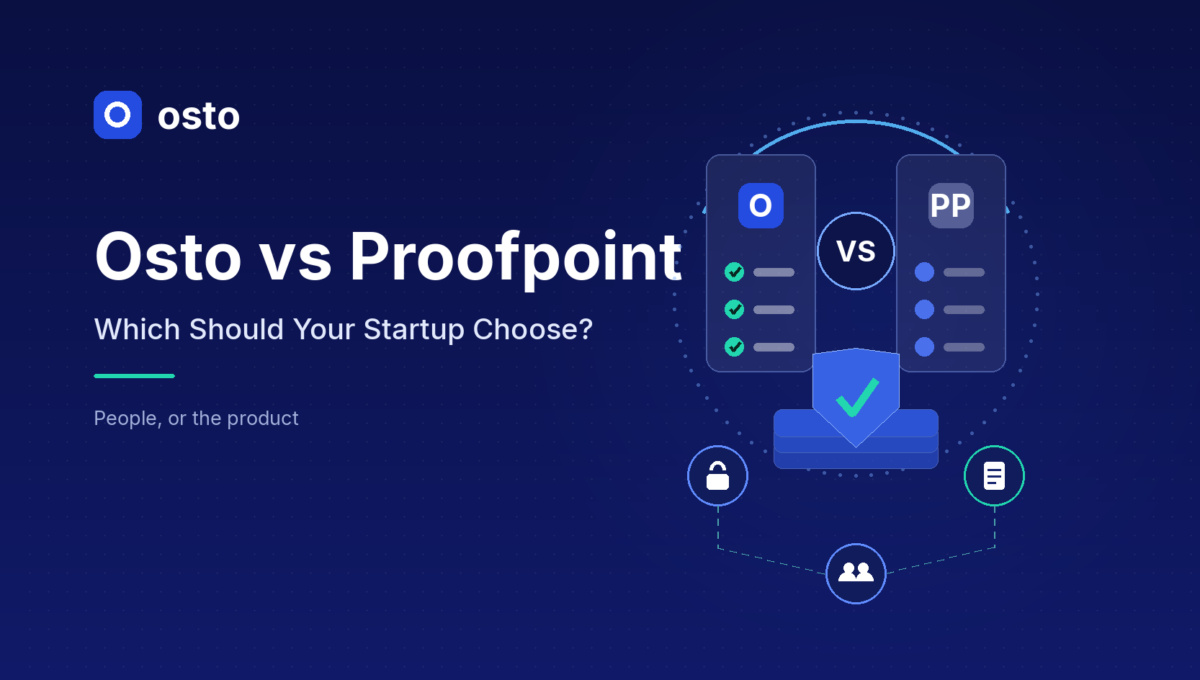
One defends your people from what lands in their inbox. The other defends the software your customers log into, and the audit that follows.
TL;DR
Osto vs Proofpoint, in one line each.
Osto is the security stack and the compliance layer in one platform. Web and API protection, cloud posture, endpoint control, ZTNA, DLP, inbound email security and VAPT are modules Osto runs, and audit evidence comes out of them.
Proofpoint is a people centric security vendor. Email threat protection, data loss prevention, insider threat, awareness training and communications governance, licensed per user for organisations with a lot of employees to protect.
The Osto vs Proofpoint question is which direction the threat comes from. Phishing aimed at your staff is real. So is a stranger probing the API you shipped last month, and only one of those shows up in a customer security review.
On this page
Osto vs Proofpoint: the core difference in one line
Proofpoint protects the people inside your company. Osto protects the product outside it, and proves the controls to an auditor.
The product, the stack, the audit
Web and API protection, cloud posture, endpoint and device control, ZTNA, DLP and inbound email security, with VAPT and compliance mapped from the controls Osto runs.
People, email and data
Email threat protection, enterprise DLP, insider threat management, awareness training and archiving for governance, priced per user across a large workforce.
Osto vs Proofpoint: the gap Osto fills
In an Osto vs Proofpoint comparison this is the decisive point. Securing your employees does nothing for the application strangers can reach. An exposed API, a public storage bucket, an unpatched dependency and the SOC 2 report your buyer wants are all outside a people centric platform.
Buy Proofpoint and you still buy this separately
- A web application firewall for your app and APIs
- Cloud posture management for AWS, Azure or GCP
- A compliance platform to map controls and hold evidence
- A penetration testing firm, per cycle
- Security questionnaire responses, done manually
- Code scanning for SAST, SCA and SBOM
- A per user licence for a workforce you are still hiring
Buy Osto and this is already included
- Reverse proxy WAAP blocking OWASP Top 10 and bots
- CSPM across AWS, Azure and GCP
- Compliance across 200 plus frameworks
- Expert led VAPT plus an AI scanner
- AI security questionnaires from live platform state
- SAST, SCA, SBOM and licence checks
- Inbound email security and awareness training included
Osto vs Proofpoint: what companies actually care about
Seven criteria decide most Osto vs Proofpoint evaluations. Each verdict below is followed by the reason behind it.
| Criteria | Osto | Proofpoint |
|---|---|---|
| Who is it for? | Startups and lean teams. Companies shipping software to enterprise. | Large workforces. Priced and scoped per employee. |
| What does it cover? | The whole surface, plus compliance. Cloud, apps, APIs, endpoints, code, testing. | Email, data and people. Threats arriving at your staff, not your product. |
| Is the product we ship protected? | Yes, at the edge. WAAP with automatic app and API discovery. | Not covered. A people centric platform does not sit in front of your app. |
| Is email security included? | Yes. Inbound email protection as a module. | Yes, in depth. It is the core of the platform. |
| Is cloud posture covered? | Yes. CSPM across AWS, Azure and GCP. | No. Misconfiguration detection sits outside the scope. |
| Is penetration testing included? | Yes. Expert led VAPT plus a scheduled AI scanner. | Not included. Testing is a separate firm and a separate cycle. |
| What does compliance mean here? | Framework readiness. 200 plus frameworks, evidence from Osto’s controls. | Records and supervision. Archiving and governance, not control attestation. |
The practical difference: In an Osto vs Proofpoint decision it comes to this. Proofpoint is built for a workforce large enough to be a target. Osto is built for a company whose product is the target, and whose next deal depends on audit evidence.
Osto vs Proofpoint: which platform fits your team?
Your people are the attack surface
Proofpoint for startups is an unusual fit, but the depth earns its place when you have hundreds of employees, heavy phishing and fraud exposure, and regulatory obligations around retaining and supervising communications.
Your product is the attack surface
You ship software, your buyers run security reviews, and you need compliance automation, VAPT and security questionnaires alongside protection. Our cybersecurity checklist for startups sets out the full list, and it is where most Osto vs Proofpoint shortlists land.
Why growing teams pick Osto in an Osto vs Proofpoint decision
Covers the product, not just the people
Protection sits in front of the application your customers reach.
Email security is included
Inbound protection and awareness training are modules, not the whole platform.
The audit layer is part of the product
Evidence is pulled from controls Osto runs and mapped to 200 plus frameworks.
Not priced per employee
Coverage does not get more expensive every time you hire.
Attackers do not always go through your inbox.
If your Osto vs Proofpoint shortlist came down to coverage, see how Osto brings cybersecurity, compliance automation, VAPT and security operations together for fast-moving teams.
Book a DemoOsto vs Proofpoint: common questions
Osto vs Proofpoint: what is the main difference?
Proofpoint is a people centric platform covering email threat protection, data loss prevention, insider threat, awareness training and communications governance, licensed per user. Osto covers apps, APIs, cloud posture, endpoints and code, and includes inbound email security, VAPT and compliance automation across 200 plus frameworks in the same platform.
Is Osto a Proofpoint alternative?
For a startup, usually yes. The Osto vs Proofpoint choice comes down to whether your exposure is a large workforce or a public product, and a Proofpoint alternative is the right search when you need the whole stack covered rather than email depth for hundreds of staff.
Does Osto include email security?
Yes. Inbound email security is a live module covering phishing and malicious payloads, and security awareness training is built in as part of the compliance programme. Proofpoint email security goes deeper for large enterprises, which is what it is designed for. For a lean team the module covers the requirement without a separate vendor.
Proofpoint has compliance products. Is that the same thing?
No, and the word does a lot of work here. Proofpoint compliance means capturing, retaining and supervising digital communications, which matters for regulated record keeping. It does not map your controls to a framework or collect evidence for an attestation. Osto covers SOC 2 and ISO 27001 end to end, with the opinion issued by an accredited independent auditor.
Will it help us pass a customer security review?
Only partly. A reviewer asks for a framework mapping, a completed questionnaire and a VAPT report, and also asks how the application itself is protected, which is a WAF question. Those are separate purchases alongside a people centric platform, and they are included with Osto.
How long does SOC 2 take with Osto?
Roughly 115 days end to end: seven days to readiness including VAPT, a mandatory three month evidence window, then around ten days of external CPA audit by an AICPA accredited firm. The evidence window is set by the standard, so no platform can remove it.