Osto and Tenable both help teams reduce cyber risk, but they are built around different security priorities. Tenable One is centered on exposure management, bringing together vulnerability management, cloud exposure, web application scanning, identity exposure, attack-surface management and other exposure data. Osto is an all-in-one cyber platform for startups and growing teams, combining preventive security, compliance automation, VAPT, security questionnaires and ongoing security support in one place.
Osto vs Tenable: comparing an all-in-one cyber platform with an exposure management platform
In an Osto vs Tenable evaluation, Tenable is designed for organisations that want broad visibility across vulnerabilities and exposures, with tools to prioritise risk across IT, cloud, web applications, identities, attack surfaces and other environments.
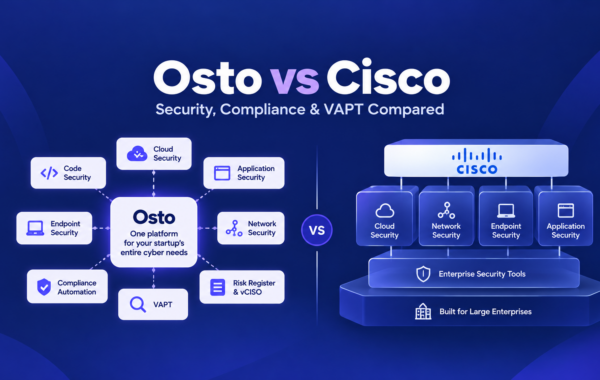
Osto is designed for growing teams that want security controls and compliance workflows to sit together, covering cloud, applications and APIs, endpoints, network/access, code security, VAPT and customer-assurance work from the same platform.
Osto vs Tenable: exposure management vs broader cyber consolidation
Tenable: exposure visibility and prioritisation
Tenable One combines vulnerability, cloud, web application, identity and attack-surface data to help teams identify exposures, understand attack paths and prioritise remediation based on risk.
Osto: security, compliance and VAPT together
Osto brings preventive controls, compliance automation, GRC-related workflows, security questionnaires, expert-led VAPT, vCISO support and cyber insurance access into one platform for startups and growing technology teams.
Osto vs Tenable: cybersecurity, compliance automation and VAPT
One of the clearest differences in an Osto vs Tenable comparison is consolidation. Osto brings together security and compliance work that a growing team may otherwise manage through multiple tools or providers. Its current platform includes:
- Cloud security: CSPM across AWS, Azure and GCP, alongside web and API protection.
- Application and API security: web app protection, API protection, web app scanning and mobile app scanning. Learn more about API security.
- Endpoint and access security: endpoint protection, device and application controls, file access DLP, disk encryption, secure server access and DNS/domain filtering.
- Code security: SAST, SCA, SBOM and licence-compliance workflows.
- Compliance: control mapping, evidence collection, security questionnaires, awareness training and audit-readiness workflows connected to live controls.
- Security assessment: expert-led VAPT and source-code assessment with remediation and retesting workflows.
Tenable goes deeper in exposure management, vulnerability intelligence and attack-surface visibility. Tenable One also extends beyond traditional vulnerability scanning into cloud exposure, web app scanning, identity exposure, attack-path analysis and OT exposure. That is why Osto vs Tenable is better understood as a comparison of operating models rather than a simple feature count.
Osto vs Tenable comparison: 7 essential cybersecurity criteria
| Criteria | Osto | Tenable |
|---|---|---|
| What is the platform mainly built around? | Consolidating preventive security, compliance automation, VAPT and ongoing cyber workflows for growing teams. | Exposure management: discovering, assessing, connecting and prioritising exposures across the attack surface. |
| How strong is vulnerability and exposure management? | Findings are surfaced through Osto’s cloud, application, code and VAPT workflows, with remediation guidance and retesting where relevant. | A core strength. Tenable combines vulnerability, threat, business and asset context to prioritise exposures and communicate risk. |
| Does it cover cloud security? | Yes. Osto provides CSPM across AWS, Azure and GCP as part of its broader security and compliance platform. | Yes. Tenable Cloud Exposure provides CNAPP capabilities including cloud asset discovery, risk analysis, identity and entitlement context, runtime threat detection and compliance visibility. |
| What about web and application security? | Osto provides runtime web and API protection plus web and mobile application scanning. | Tenable One Web App Scanning provides automated DAST and API scanning for running web applications. |
| Does it cover identity exposure? | Osto includes access-security capabilities such as secure server access and related identity/access controls within the broader platform. | Yes. Tenable One Identity Exposure is a dedicated product for identifying and reducing identity-related exposure. |
| Can it support compliance and audit readiness? | Yes. Osto connects compliance automation, evidence collection, questionnaires and GRC-related workflows to the controls operating in the platform. | Tenable supports compliance assessment and configuration visibility within several products, particularly vulnerability and cloud-security workflows, but its primary platform positioning is exposure management rather than end-to-end compliance automation. |
| Is penetration testing available? | Yes. Expert-led VAPT is part of Osto’s platform offering, with remediation support and retesting. | Tenable is primarily known for automated assessment and exposure-management tooling. Teams that require a human-led penetration test should evaluate the specific service or provider needed for that testing requirement. |
Osto vs Tenable: which cybersecurity platform fits your team?
Tenable may make sense when
- Exposure management and vulnerability prioritisation are major parts of your security program.
- You need visibility across a large or complex mix of IT, cloud, identity, web application or OT assets.
- Your team wants attack-path analysis and risk prioritisation across multiple security domains.
- You already have other tools for preventive controls, compliance workflows and specialist services, and want a strong exposure-management layer.
Osto may make sense when
- You want to consolidate preventive security, compliance automation and VAPT into fewer tools and providers.
- Your requirements span cloud, applications, APIs, endpoints, network/access and code security.
- Audit readiness, evidence, security questionnaires and customer assurance are closely tied to your security work.
- You are looking for a Tenable alternative for startups where broader cyber consolidation matters as much as exposure visibility.
Can Osto and Tenable work together?
Yes. In some Osto vs Tenable scenarios, the platforms can complement each other. A company may use Tenable for exposure management and vulnerability prioritisation while using Osto for preventive security controls, compliance automation, VAPT and startup-focused security workflows. Whether that combination is useful depends on your existing stack, team structure and security priorities.
Osto vs Tenable: common questions
What is the main difference between Osto and Tenable?
Tenable is primarily an exposure-management platform that helps organisations discover, assess and prioritise vulnerabilities and exposures across IT, cloud, web applications, identity and other environments. Osto combines preventive security controls with compliance automation, VAPT and security-support workflows in one platform for startups and growing teams.
Is Osto a Tenable alternative for startups?
It can be, depending on the requirement. Osto is relevant when a startup wants broader consolidation across security, compliance automation and VAPT. Tenable is especially relevant when exposure management, vulnerability intelligence and attack-surface visibility are the primary requirements.
Does Tenable provide cloud security?
Yes. Tenable Cloud Exposure is a CNAPP that combines cloud asset discovery, risk analysis, identity and entitlement context, runtime threat detection, vulnerability coverage and compliance visibility.
Does Tenable scan web applications and APIs?
Yes. Tenable One Web App Scanning provides automated DAST and API scanning for modern web applications, including recurring scans and integrated vulnerability dashboards.
Is a Tenable vulnerability scan the same as a penetration test?
No. Automated vulnerability scanning and human-led penetration testing serve different purposes. A scanner identifies known vulnerabilities and configuration issues at scale, while a penetration test involves expert-led testing of whether weaknesses can be exploited within an agreed scope. Teams should choose the assessment based on the requirement they need to satisfy.
How long does SOC 2 Type II take?
A SOC 2 Type II report includes an observation period. The appropriate period is agreed with the independent CPA firm and commonly runs for several months. Total timing depends on readiness, scope, remediation work and auditor scheduling. For the underlying SOC 2 criteria and reporting resources, see the AICPA SOC 2 resources.
Bring more of your startup’s cyber program into one place
See how Osto combines security, compliance automation, VAPT and ongoing cyber workflows for growing teams.
Talk to Osto