SBI found customer information in a much larger set of records circulating on the dark web. The source is still unknown. Here is what the bank has confirmed, what the risks are, and what customers should know.

Imagine receiving a call from someone who knows your name, bank branch, date of birth and details of a loan enquiry. The person sounds convincing. But knowing those details does not mean they actually work for your bank.
The suspected SBI data breach deserves attention because personal information can help scammers sound believable, even without a stolen password.
What happened in the suspected SBI data breach?
On October 21, 2026, SBI informed the stock exchanges that it had experienced an incident involving the loss of certain data.
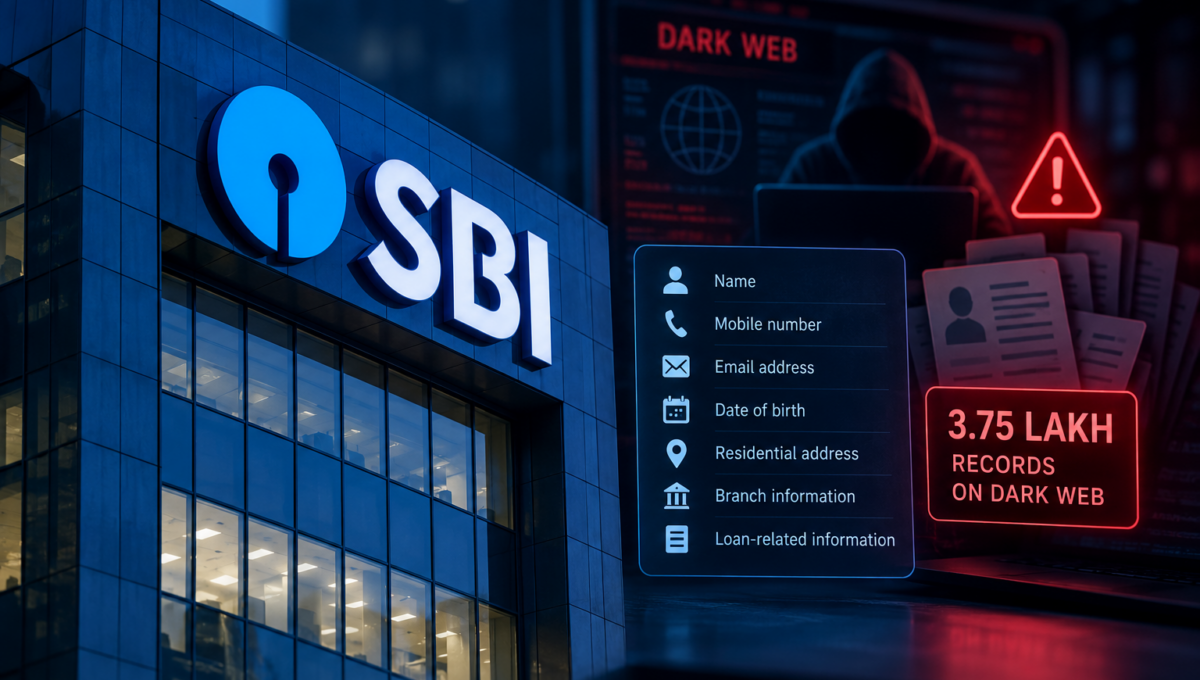
The bank said it reviewed approximately 375,000 records available on the dark web and identified 3,897 customer records containing personal information. The figures are preliminary.
The dark web is a part of the internet where stolen information may be shared or offered for sale. Finding information there is serious, but it does not by itself establish how the information got there.
What information was reportedly exposed?
According to SBI’s filing, the information reportedly included:
- Customer names, mobile numbers and email addresses
- Dates of birth, gender and residential addresses
- Bank branch details and Customer Information File (CIF) identifiers
- Lead IDs and information connected to loan enquiries and related records
A CIF identifier is a number used by a bank to organise a customer’s information. It is not the same as a bank account password.
Why does this matter if passwords were not reported stolen?
Because scammers do not always need to break into an account first. Sometimes, they try to convince the account holder to give them access.
For example, a scammer who knows your bank branch and loan enquiry details could say, “I’m calling from SBI about your loan application.” They might then ask you to share an OTP or open a link.
That technique is called social engineering: using believable information to trick a person into taking an unsafe action.
These are possible risks, not evidence that scammers have already used the SBI records in this way.
What has SBI done so far?
SBI says it received alerts from its threat intelligence provider, CERT-In and the Defence Cyber Agency about suspected customer data exposure.
The bank activated its incident response and containment procedures and engaged an independent cybersecurity agency empanelled by CERT-In.
SBI publicly disclosed the incident in a stock exchange filing and said further analysis was underway.
SBI said there was no material impact on its core business operations, financial performance or business continuity. Its core banking functions were continuing without disruption.
That is reassuring for service availability, but it is a separate question from whether exposed personal data could put particular customers at risk.
What is still unknown?
The SBI data breach investigation has not yet established several important facts:
- Where the information came from. The bank has not confirmed whether it originated from its own systems or somewhere else.
- How complete or authentic the records are. SBI’s assessment was preliminary.
- How many different people are affected. A count of records is not necessarily a count of individuals.
- Whether additional information is involved. The review is continuing.
Until those questions are answered, it would be misleading to describe a particular system, vendor or attack method as the confirmed cause.
What should SBI customers do?
There is no need to panic, but a few simple precautions matter:
- Be careful with unexpected bank calls. Hang up and contact the bank through its official website, app or a trusted phone number.
- Never share an OTP, PIN or password with someone who calls or messages you.
- Avoid links in urgent messages claiming that your account, KYC or loan application needs immediate action.
- Check account activity and report unfamiliar transactions promptly.
- If you suspect financial cyber fraud in India, contact the national cybercrime helpline at 1930 or visit cybercrime.gov.in.
These are general safety steps, not a claim that every SBI customer has been affected.
What the SBI data breach investigation teaches businesses
Every organisation collects information about customers: names, contact details, addresses and sometimes much more. That information can move between teams, applications and outside service providers.
The SBI data breach investigation illustrates a wider challenge: organisations must not only keep systems running, but also know where customer information is held, who can access it and how quickly a possible exposure can be investigated.
That requires good access controls, careful handling of customer records, oversight of service providers and an incident response process that works when something goes wrong.
Security should be simpler for growing businesses.
Osto is a one-stop cyber platform built for startups, bringing together security across cloud, code, endpoints, networks, web applications and APIs, alongside compliance workflows, VAPT, security questionnaires and expert guidance.
Our approach is simple: help growing companies build a stronger security foundation while making everyday cybersecurity easier to manage.
Explore OstoPrimary source: SBI stock exchange disclosure, October 21, 2026. Additional reporting: Hindustan Times and The New Indian Express.
This article reflects information available as of October 23, 2026. The cause, authenticity and full scope of the exposure are still under investigation. Hypothetical fraud examples describe possible risks, not confirmed misuse of these records.