
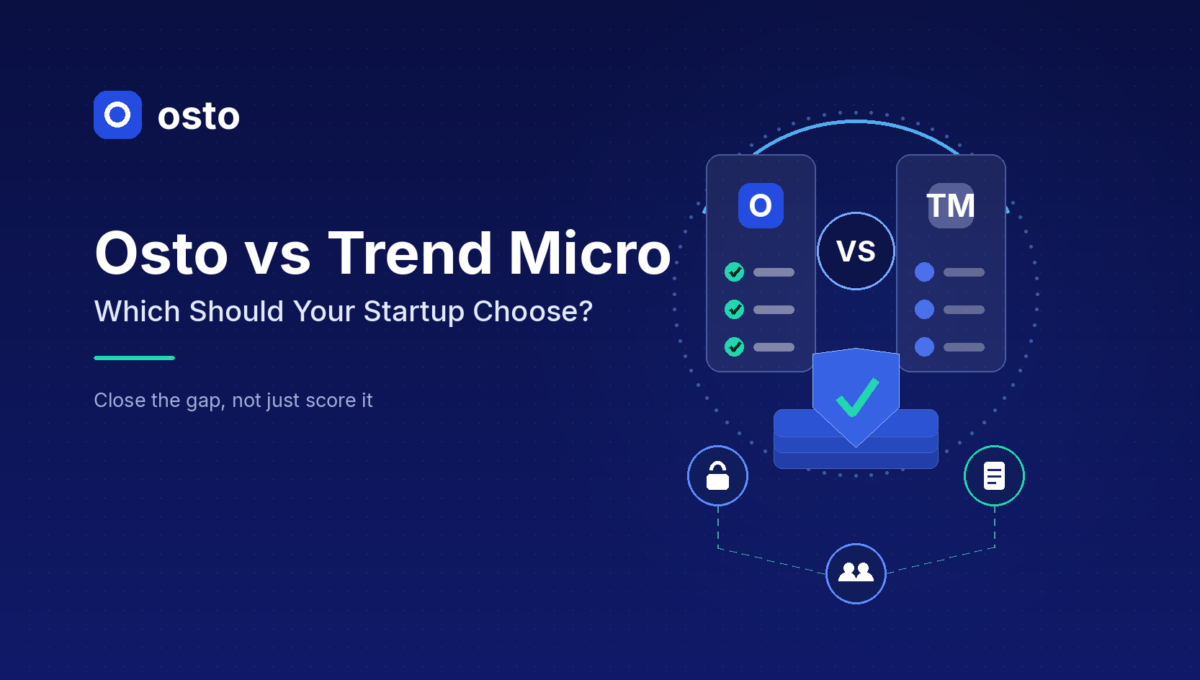
One tells you how exposed you are. The other closes the exposure and proves it to your auditor.
TL;DR
Osto vs Trend Micro, in one line each.
Osto is the security stack and the compliance layer in one platform. Web and API protection, cloud posture, endpoint control, ZTNA, DLP and VAPT are modules Osto runs, and audit evidence comes out of them.
Trend Micro is an enterprise platform spanning endpoint, cloud, email, network and identity, with a cyber risk exposure score on top. It is licensed through partners on a credit model, with capability drawn down as you consume it.
The Osto vs Trend Micro question is what you get for the spend. A risk index that ranks your exposure is useful when you have a team to act on it. A startup usually needs the exposure closed and the evidence filed, not scored.
On this page
Osto vs Trend Micro: the core difference in one line
Trend Micro measures and monitors risk across an enterprise estate. Osto runs the controls that remove the risk, and turns them into audit evidence.
Controls that run, evidence that follows
Web and API protection, cloud posture, endpoint and device control, ZTNA, DLP, VAPT and code security, with compliance mapped from the controls Osto runs.
Broad estate coverage, scored
Endpoint, cloud, email, network and identity protection with XDR and a cyber risk exposure rating, sold through the channel and drawn against purchased credits.
Osto vs Trend Micro: the gap Osto fills
In an Osto vs Trend Micro comparison this is the decisive point. A risk score is not audit evidence. An auditor does not accept a dashboard rating as proof that a control operated for three months, and a security questionnaire asks what you have implemented, not how you rank.
Buy Trend Micro and you still buy this separately
- A compliance platform to map controls to a framework
- Evidence collection for the audit window
- A penetration testing firm, per cycle
- Security questionnaire responses, done manually
- A reverse proxy WAF in front of your application
- Credits forecast a year ahead, then topped up
- A partner relationship to buy and renew through
Buy Osto and this is already included
- Compliance across 200 plus frameworks
- Evidence pulled from the controls Osto runs
- Expert led VAPT plus an AI scanner
- AI security questionnaires from live platform state
- Reverse proxy WAAP blocking OWASP Top 10 and bots
- Every module included, nothing to draw down
- Direct onboarding, no reseller in the middle
Osto vs Trend Micro: what companies actually care about
Seven criteria decide most Osto vs Trend Micro evaluations. Each verdict below is followed by the reason behind it.
| Criteria | Osto | Trend Micro |
|---|---|---|
| Who is it for? | Startups and lean teams. No security function required. | Enterprises with a security team. Bought through a partner, not self serve. |
| What does it cover? | The whole surface, plus compliance. Cloud, apps, APIs, endpoints, code, testing. | Endpoint, cloud, email, network, identity. Oriented to estate protection and detection. |
| Is the product we ship protected? | Yes, at the edge. WAAP with automatic app and API discovery. | Not the model. Coverage centres on workloads and infrastructure. |
| Is penetration testing included? | Yes. Expert led VAPT plus a scheduled AI scanner. | Sold as a service. Red teaming is a separate engagement. |
| What does compliance look like? | Built in. 200 plus frameworks, evidence from Osto’s controls. | Risk scoring only. Exposure ratings are not audit evidence. |
| How is it priced? | One platform. Every module included, one predictable bill. | Credit based, via partner. Consumption forecast up front, topped up later. |
| Do I need someone to run it? | No. Controls run on the platform, vCISO if needed. | Usually yes. A risk index needs someone to act on it. |
The practical difference: In an Osto vs Trend Micro decision it comes to this. Trend Micro is built for an estate large enough to need risk prioritisation. Osto is built to close the gaps and hand you the SOC 2 evidence at the end of it.
Osto vs Trend Micro: which platform fits your team?
You run a large estate with a security team
Trend Micro for startups is an unusual fit, but the platform earns its place when you have thousands of endpoints across offices and clouds, analysts to work the detections, and procurement comfortable with channel purchasing.
You want security and compliance solved together
You need the gaps closed rather than ranked, with compliance automation, VAPT and questionnaires in the same platform. Our cybersecurity checklist for startups covers what a lean team actually has to own. That is where most Osto vs Trend Micro shortlists land.
Why growing teams pick Osto in an Osto vs Trend Micro decision
Exposure closed, not scored
Controls run on the platform instead of producing a list of things to fix.
The product you ship is covered
A self configuring WAF applies positive security policy without hand written rules.
The audit layer is part of the product
Evidence is pulled from controls Osto runs and mapped to 200 plus frameworks.
Bought directly, priced simply
No credit forecasting, no reseller quote cycle, no consumption surprises.
Close the gap, do not just measure it.
If your Osto vs Trend Micro shortlist came down to coverage, see how Osto brings cybersecurity, compliance automation, VAPT and security operations together for fast-moving teams.
Book a DemoOsto vs Trend Micro: common questions
Osto vs Trend Micro: what is the main difference?
Trend Micro is an enterprise security platform covering endpoint, cloud, email, network and identity, with cyber risk exposure scoring, licensed through partners on a credit model. Osto combines cybersecurity across cloud, apps, APIs, endpoints and code with compliance automation, VAPT and security questionnaires in a single platform bought directly.
Is Osto a Trend Micro alternative?
For a startup, yes. Osto covers the layers a small company is actually judged on and adds the audit layer that enterprise platforms leave out. A Trend Micro alternative for a large multinational estate is a different search, and the answer there is usually another enterprise vendor. If you are shortlisting enterprise platforms, Osto vs CrowdStrike covers similar ground.
Does a cyber risk score help with SOC 2?
Only as an input. Trend Micro compliance value sits in visibility and prioritisation, not in mapping controls to a framework or collecting evidence across the audit window. An auditor tests whether a control operated, so a rating on a dashboard does not substitute for the artefacts. Osto covers 200 plus frameworks end to end, with the opinion issued by an accredited independent auditor, and the same holds for ISO 27001.
Will it protect the application our customers log into?
Not in the way a startup needs, and it is the gap most Osto vs Trend Micro comparisons miss. The platform is oriented to endpoints, workloads, email and network traffic rather than sitting as a reverse proxy in front of your app and APIs. That needs a web application firewall, which Osto includes with automatic discovery and VAPT alongside it.
How does credit based licensing work out for a small team?
It asks you to forecast consumption before you know it. Trend Micro pricing draws capability against credits bought up front through a partner, which suits procurement cycles more than a team of fifteen. Osto includes every module in one platform, so nothing runs out mid year, which is usually the deciding factor in an Osto vs Trend Micro evaluation for a small team.
How long does SOC 2 take with Osto?
Roughly 115 days end to end: seven days to readiness including VAPT, a mandatory three month evidence window, then around ten days of external CPA audit by an AICPA accredited firm. The evidence window is set by the standard, so no platform can remove it.