
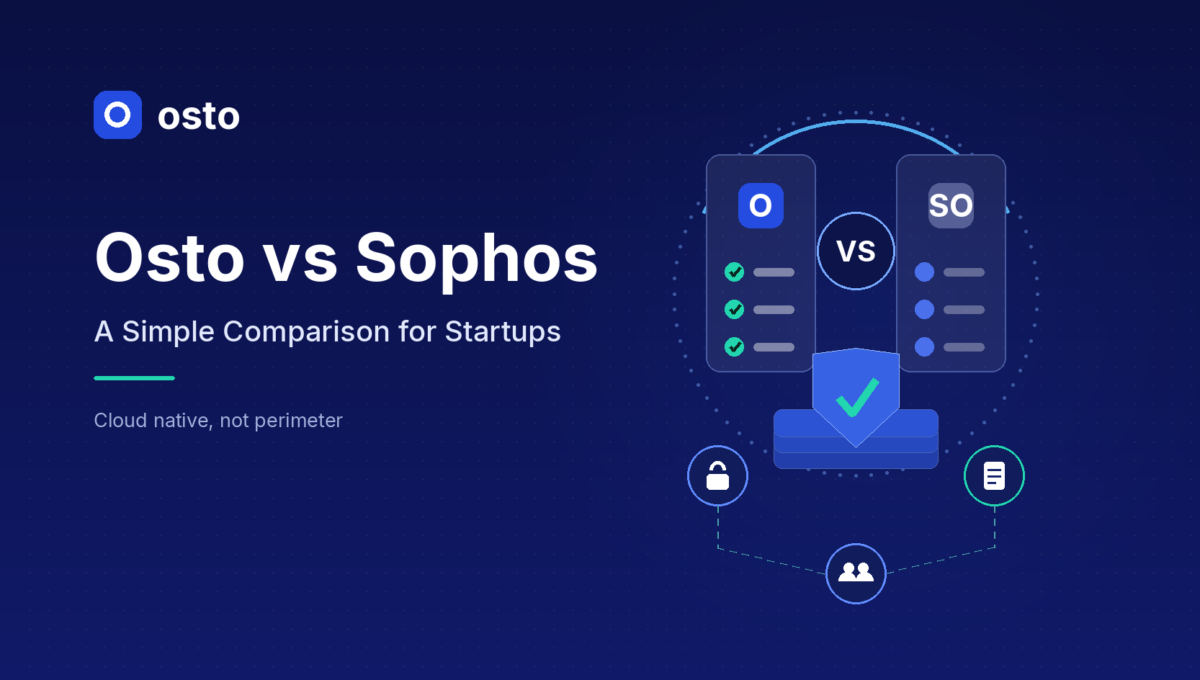
One protects the office, the devices and the network around it. The other protects the product you sell, and the audit that comes with selling it.
TL;DR
Osto vs Sophos, in one line each.
Osto is the security stack and the compliance layer in one platform. Web and API protection, cloud posture, endpoint control, ZTNA, DLP and VAPT are modules Osto runs, and audit evidence comes out of them.
Sophos is an endpoint, firewall and managed detection vendor built around Sophos Central, with hardware for the network edge and managed response as the flagship service. It is bought and renewed through partners and managed service providers.
The Osto vs Sophos question is not about company size. Both are built for teams without a security department. The split is what gets protected: the estate your staff work on, or the software your customers log into.
On this page
Osto vs Sophos: the core difference in one line
Sophos secures the office, the devices and the network perimeter. Osto secures the cloud product you ship, and the audit your buyers ask for.
Cloud native, audit ready
Web and API protection, cloud posture, endpoint and device control, ZTNA, DLP, VAPT and code security, with compliance mapped from the controls Osto runs.
Devices, perimeter and managed response
Endpoint protection, next generation firewall appliances, email and workspace security, managed through a central console with detection handled as a service.
Osto vs Sophos: the gap Osto fills
In an Osto vs Sophos comparison this is the decisive point. A firewall appliance protects a site. A cloud native startup has no site to defend, and the things it is judged on are the API it exposed, the storage bucket it misconfigured, the dependency it never patched and the SOC 2 report the buyer asked for before signing.
Buy Sophos and you still buy this separately
- A web application firewall in front of your app and APIs
- Cloud posture management for AWS, Azure or GCP
- A compliance platform to map controls and hold evidence
- A penetration testing firm, per cycle
- Security questionnaire responses, done manually
- Code scanning for SAST, SCA and SBOM
- A partner or MSP relationship to buy and renew through
Buy Osto and this is already included
- Reverse proxy WAAP blocking OWASP Top 10 and bots
- CSPM across AWS, Azure and GCP
- Compliance across 200 plus frameworks
- Expert led VAPT plus an AI scanner
- AI security questionnaires from live platform state
- SAST, SCA, SBOM and licence checks
- Direct onboarding, no reseller in the middle
Osto vs Sophos: what companies actually care about
Seven criteria decide most Osto vs Sophos evaluations. Each verdict below is followed by the reason behind it.
| Criteria | Osto | Sophos |
|---|---|---|
| Who is it for? | Cloud native startups. Teams shipping software to enterprise buyers. | Small and mid sized businesses. Offices, networks and managed devices. |
| What does it cover? | The whole surface, plus compliance. Cloud, apps, APIs, endpoints, code, testing. | Endpoint, firewall, email, workspace. Cloud workload protection is a separate product. |
| Is the product we ship protected? | Yes, at the edge. WAAP with automatic app and API discovery. | Not covered. Perimeter firewalling is not application firewalling. |
| Is cloud posture covered? | Yes. CSPM across AWS, Azure and GCP. | Partly. Workload protection, not full posture management. |
| Is penetration testing included? | Yes. Expert led VAPT plus a scheduled AI scanner. | Sold as a service. Security testing is a separate engagement. |
| What does compliance look like? | Built in. 200 plus frameworks, evidence from Osto’s controls. | Not included. No control mapping, evidence or questionnaires. |
| How do you buy it? | Direct. One platform, one contract, one bill. | Through a partner. Licences and hardware via reseller or MSP. |
The practical difference: In an Osto vs Sophos decision it comes to this. Sophos is strong where the risk is physical and local. Osto is built where the risk is public and cloud hosted, and it carries the audit evidence with it.
Osto vs Sophos: which platform fits your team?
Your risk is offices, devices and a network
Sophos for startups fits when you run physical sites, need firewall hardware and want someone else watching detections around the clock, with application security and compliance handled elsewhere.
Your risk is the software you sell
You are cloud native, your customers reach you over the internet, and you need compliance automation, VAPT and security questionnaires in the same place as the controls. Our cybersecurity checklist for startups sets out what that covers.
Why growing teams pick Osto in an Osto vs Sophos decision
Built for cloud, not the perimeter
No appliance to rack, no site to defend, protection sits in front of your application.
The audit layer is part of the product
Evidence is pulled from controls Osto runs and mapped to 200 plus frameworks.
Testing included, not quoted
Expert led VAPT and scheduled scanning, with remediation and retest reports.
Bought directly
One contract with the vendor, no reseller quote cycle or renewal chase.
Your customers are not on your network.
If your Osto vs Sophos shortlist came down to coverage, see how Osto brings cybersecurity, compliance automation, VAPT and security operations together for fast-moving teams.
Book a DemoOsto vs Sophos: common questions
Osto vs Sophos: what is the main difference?
Sophos protects devices, offices and network perimeters through endpoint software, firewall appliances and managed detection, bought via partners. Osto protects cloud native companies across apps, APIs, cloud posture, endpoints and code, and includes compliance automation, VAPT and security questionnaires in the same platform.
Is Osto a Sophos alternative?
For a software company, yes. The Osto vs Sophos choice usually splits on where the risk sits, and a Sophos alternative is the right search when your exposure is a public cloud application rather than an office network. Osto includes endpoint antimalware and device control, so the device layer is still covered.
Does a firewall appliance protect our web application?
No. A network firewall controls traffic at the boundary of a site. It does not inspect requests hitting your public API for injection, bot or OWASP Top 10 attacks, and a remote team on home broadband sits outside it entirely. That needs a web application firewall, which Osto includes with automatic discovery.
Does managed detection cover what an auditor asks for?
No, and this is where Osto vs Sophos separates. Sophos MDR answers who watches alerts at three in the morning. An auditor asks something different: which controls are in place, whether they operated across the window, and where the evidence is. Osto covers 200 plus frameworks including ISO 27001, with the opinion issued by an accredited independent auditor.
Will Sophos get us through a customer security review?
Only in part. Sophos compliance value is having controls you can point to, which helps, but a vendor review asks for a VAPT report, a framework mapping and a completed questionnaire. Those are separate purchases alongside it, and they are included with Osto.
How long does SOC 2 take with Osto?
Roughly 115 days end to end: seven days to readiness including VAPT, a mandatory three month evidence window, then around ten days of external CPA audit by an AICPA accredited firm. The evidence window is set by the standard, so no platform can remove it.