
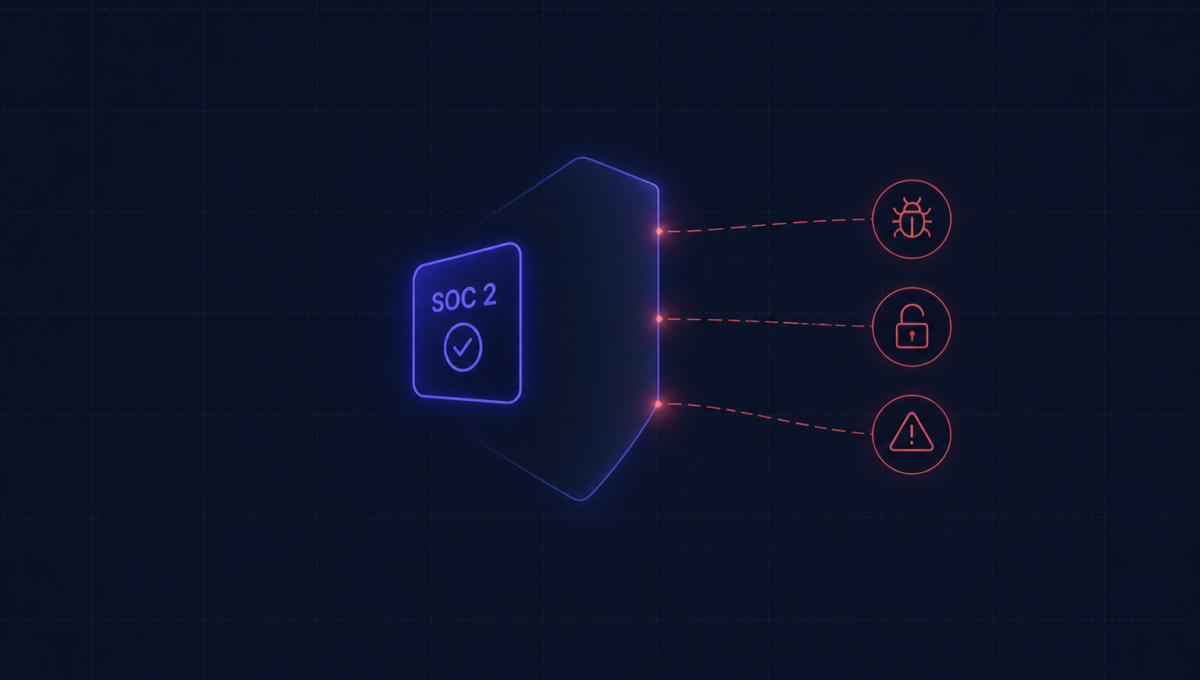
Paper compliance vs real security is the gap behind every SOC 2 badge that did not stop a breach. A SOC 2 audit is the start of security, not the proof of it. Here is what real security infrastructure looks like once the audit is over.
Table of Contents
You did everything right.
You connected your cloud environment to a compliance platform. You documented your policies, ran your controls for six months, hired an auditor, and received your SOC 2 Type II report. You added the badge to your security page. You can now answer the enterprise questionnaire in under an hour.
Three months later, a misconfigured S3 bucket exposes your customer database.
The breach is real. The SOC 2 was also real. Both things are true at the same time — and this is the part nobody in the compliance industry says out loud.
What SOC 2 actually measures
SOC 2 is a backward-looking attestation. An auditor reviews evidence from your observation period and confirms that your documented security controls operated as described during that time.
That’s genuinely valuable. A well-run SOC 2 tells your enterprise prospects that your security program has structure, your controls were independently verified, and your team takes documentation seriously.
What it doesn’t tell anyone: whether your web application is protected from attacks happening right now. Whether a credential stolen from your team this week could reach your production database. Whether the cloud resource your engineer created last Tuesday is publicly readable.
The evidence collection trap
Modern compliance platforms work by connecting to your cloud providers and infrastructure tools, then automatically pulling configuration data and logs to build your evidence library. This is genuinely useful. It replaces months of manual spreadsheet work.
The issue is that evidence collection is only meaningful if there’s real security infrastructure generating the evidence.
If your web application has a WAF actively blocking attacks, those logs become SOC 2 evidence. If your endpoints have EDR running and detecting threats, those records become SOC 2 evidence. If your cloud environment has continuous posture monitoring flagging misconfigurations, those findings and remediations become SOC 2 evidence.
But if you go straight to a compliance tool without that underlying infrastructure, you’re collecting evidence of access logs, configuration defaults, and policy acknowledgment clicks. The audit passes because the controls are documented. The attacker succeeds because the controls aren’t blocking anything.
The compliance tool documents your security. It doesn’t build it. That distinction matters more than most people realise until they need it.
How real breaches happen at companies with valid SOC 2 reports
A developer creates a new cloud storage bucket late in a sprint. Clicks through default settings without registering that public access is enabled. The change doesn’t go through formal change management because it feels temporary. The SOC 2 audit tested your change management controls and they passed for 95% of changes. This one slipped through. A WAF doesn’t catch a storage misconfiguration. Continuous cloud posture management does.
A phishing email reaches an engineer. It’s convincing enough. They enter credentials on a fake login page. The attacker authenticates to your production environment using legitimate credentials. All your access controls are enforced correctly, because the attacker is using real credentials obtained through social engineering. Endpoint detection and response, which monitors for behavioral anomalies on the device where the credentials were stolen, catches this. SOC 2 controls don’t.
Your penetration test covered the main application endpoints. A new endpoint added three months later wasn’t included in scope. An automated scanner finds it in 20 minutes. The attacker spends weeks quietly extracting customer records at a low enough volume to avoid rate limiting. Your SOC 2 verified your penetration testing process. The audit passed. The exfiltration happened.
What real security looks like alongside compliance
The right frame isn’t ‘compliance OR security.’ It’s understanding that they serve different purposes and need to be built in the right order.
WAF, EDR, zero trust access, continuous cloud posture management, and annual penetration testing.
Structured proof that your protection layer exists and has been running consistently.
Build the protection layer first. Run it for six months. Let the compliance documentation be evidence of a real security program, not a substitute for one.
When that sequence is followed, the SOC 2 report is genuinely meaningful. It tells your enterprise prospects that the controls it describes are actively protecting your platform. That’s the version of the badge that closes deals and earns trust.
A practical self-check
Look at your production environment and ask: if an attacker successfully ran a SQL injection attack against your application right now, what would stop them?
Defense in depth means multiple layers, each catching what the previous one misses. Most early-stage B2B SaaS companies have one layer, their application code, and nothing else. A SOC 2 can still pass. The protection isn’t there.
The goal is a program where the compliance badge reflects reality. That requires building the infrastructure before the documentation. It’s more work upfront. It’s also the only version that holds up when something actually happens.
Frequently asked questions
What is the difference between paper compliance and real security?
Paper compliance is the documented controls that pass a SOC 2 audit. Real security is the infrastructure that actually blocks an attack. A SOC 2 badge proves the first. It does not prove the second.
Does a SOC 2 badge mean a company is secure?
No. SOC 2 confirms that documented controls operated as described. Companies with valid SOC 2 reports still get breached because the audit does not test running production controls against a real attacker.
What does real security infrastructure look like beyond SOC 2?
Real security infrastructure includes a deployed WAF, cloud posture monitoring, endpoint protection, code security, and an actively monitored logs pipeline. SOC 2 confirms the policy. The infrastructure confirms the defence.