
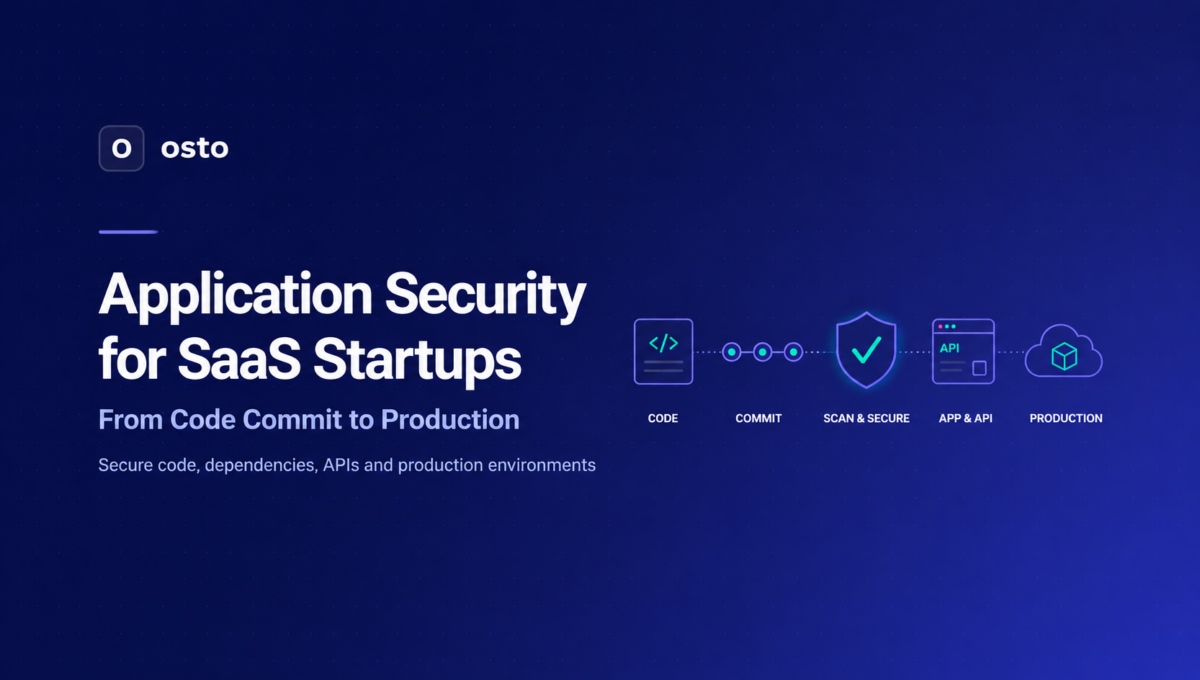
Application security for SaaS startups is the discipline of protecting your product from the moment code is written until the application is running in production. For founders and CTOs, the real challenge is not choosing one security tool. It is making sure code, dependencies, CI/CD, APIs, cloud configuration, runtime protection and VAPT work together as one operating model.
That challenge usually appears when a startup starts storing more customer data, shipping faster, opening APIs, hiring more engineers or selling to larger customers. Suddenly the questions become practical: Where do we scan code? Who reviews findings? Do we protect APIs separately? What still needs an independent pentest? And how do we prove any of this to customers?
TL;DR
Application security for SaaS startups should not be treated as a one-time scan before release. A stronger approach covers the full path from code commit to production: secure development practices, dependency and secret checks, build and CI/CD controls, API and web application protection, cloud hardening, vulnerability management, and periodic independent VAPT. The goal is not to add security steps for the sake of it. The goal is to reduce exploitable risk without slowing engineering, while also keeping enough evidence ready for enterprise customers, compliance audits and security questionnaires.
What application security means for SaaS startups
Application security is not only about finding vulnerabilities in source code. In a SaaS environment, weaknesses can appear across the full delivery chain: insecure coding patterns, exposed secrets, risky open-source dependencies, weak CI/CD controls, unprotected APIs, cloud misconfigurations, missing runtime visibility, or unresolved pentest findings.
That is why application security for SaaS startups is best understood as a system rather than a single test. It connects how software is built, how it is deployed, and how it is protected once live.
For teams formalizing their secure development practices, the NIST Secure Software Development Framework (SSDF) provides a useful reference for integrating security into the software development lifecycle. The OWASP Application Security Verification Standard (ASVS) is another practical benchmark for defining and verifying web application security requirements.
For a SaaS startup, the practical goal is simple: catch risk earlier, protect what is live, and make remediation visible.
Build securely
Catch weaknesses in code, dependencies, configurations and secrets before they reach production.
Protect the live app
Secure web applications, APIs and production infrastructure against real-world attacks.
Close the loop
Track findings, remediate them, retest where needed and keep evidence ready for customers and audits.
Why application security becomes urgent for SaaS startups
Many early startups think application security can wait until after product-market fit. In practice, it becomes urgent much earlier because customer trust, engineering speed and production risk start converging. A practical application security for SaaS startups program should therefore grow with the product rather than appear only when a large customer asks for proof.
- ✓Enterprise buyers ask earlier. Security reviews often begin before a startup has a dedicated security team.
- ✓Attack surface grows fast. New APIs, admin panels, mobile apps, cloud resources and third-party integrations introduce fresh risk.
- ✓Engineering velocity increases. More releases mean more opportunity for risky code, misconfiguration and dependency drift.
- ✓One issue can become a business problem. A critical vulnerability can delay a deal, trigger a questionnaire escalation or create an incident response crisis.
This is also why application security should not sit in isolation from broader startup security work. If you have not yet reviewed your overall foundation, Osto’s Cybersecurity Checklist for Startups is a useful companion resource.
Application security for SaaS startups: from code commit to production
The easiest way to make this practical is to view application security as a pipeline. Each stage has a different job. Together, they create coverage that is much stronger than a last-minute scan before go-live.
Code
Secure coding practices, peer review, branch protections and early SAST checks reduce avoidable weaknesses.
Dependencies
SCA and SBOM visibility help you identify vulnerable libraries, risky packages and supply-chain exposure.
Secrets & CI/CD
Secrets should not leak into repositories, pipelines should be controlled, and build permissions should stay limited.
App & API
Web applications and APIs need scanning, policy enforcement, WAF coverage and input validation.
Cloud & runtime
Production environments need secure configuration, monitoring, access control and visibility into exposed assets.
VAPT & remediation
Periodic independent testing validates real-world exposure and confirms whether important weaknesses are actually closed.
The sequence is not strictly linear. Mature teams run multiple controls continuously, but this model helps founders and CTOs see how the pieces connect.
The core application security controls that matter most
1. Secure code review and SAST
Use secure code review and static analysis to detect risky patterns early. The goal is not just to generate findings. It is to catch issues close enough to development that engineers can fix them quickly.
2. Dependency security and SBOM
Most SaaS products depend heavily on open-source libraries. Track vulnerable packages, maintain software inventory and prioritize exploitable issues rather than trying to fix everything blindly.
3. Secret detection
Credentials, API keys and tokens should never quietly live in repositories, scripts or build logs. Secret scanning helps prevent that problem from becoming a production incident.
4. API and web app protection
Modern SaaS applications expose APIs everywhere. Protect them with schema validation, WAF policies, rate protections and visibility into abnormal requests.
5. Cloud posture and production hardening
Application security fails quickly when the cloud environment behind the application is misconfigured. Production access, security groups, public assets, storage settings and logging all matter.
6. Vulnerability management and VAPT
Findings from scans and pentests should flow into one remediation process with owners, timelines and retesting where appropriate.
Startups often ask whether these controls are “too much” for a lean engineering team. Usually the better question is which parts should be automated continuously and which parts still need expert-led testing. For application security for SaaS startups, that distinction matters because scanning and VAPT are not interchangeable.
Continuous security vs periodic VAPT
One of the biggest application security mistakes is assuming that a scanner and a pentest are the same thing. They are not. Both are useful, but they solve different problems. Strong application security for SaaS startups combines continuous visibility with periodic independent validation.
| Activity | Best use | What it helps answer |
|---|---|---|
| SAST / dependency / secret scanning | Continuous detection during development | What risks are being introduced into code and packages as we build? |
| Web and API scanning | Ongoing exposure checks for internet-facing assets | Are obvious weaknesses or attack paths present in the live app? |
| Cloud posture monitoring | Continuous configuration visibility | Is the production environment drifting into insecure states? |
| Independent VAPT | Deeper periodic validation by specialists | Can a skilled tester chain weaknesses together or uncover logic flaws the automation misses? |
| Remediation tracking | Operational follow-through | Are the important findings actually getting fixed and closed? |
This distinction also matters during customer reviews. Many enterprise buyers do not just ask whether you “scan the app.” They ask whether you perform independent penetration testing and whether material findings are remediated. If security questionnaires are becoming part of your sales cycle, Osto’s Security Questionnaires for Startups guide explains how to prepare evidence and answer more accurately.
A practical implementation path for lean engineering teams
Application security for SaaS startups works best when it is implemented in stages. The goal is to reduce meaningful risk first, then deepen the program as customer expectations and engineering complexity grow. This keeps security close to engineering instead of turning it into a separate last-minute project.
Map the application surface
List repositories, services, APIs, admin surfaces, production environments and third-party integrations. If you do not know the scope, you cannot protect it well.
Protect the development flow
Introduce code review discipline, branch controls, SAST, dependency checks and secret detection into the existing development process.
Secure CI/CD and release paths
Limit who can change pipelines, manage secrets securely, and ensure build and deployment permissions are intentionally controlled.
Protect runtime and APIs
Layer in web and API protection, cloud posture visibility, secure production access and monitoring for exposed services.
Run independent VAPT
Use periodic expert-led testing to validate real-world exposure. The biggest value often comes from how findings are prioritized and remediated afterward.
Keep the evidence ready
Store reports, remediation records, coverage details and relevant policies so customer security reviews do not become a scramble.
What evidence to keep ready for customers and audits
Startups usually discover the evidence problem after the controls problem. A buyer, auditor or insurer asks for proof, and the team has to reconstruct everything. For application security for SaaS startups, it is much easier to maintain a simple evidence pack as you go.
Code security evidence
SAST coverage, repository protections, dependency reports, SBOMs and secret-scanning status.
Application and API evidence
Web scanning status, WAF or API protection details, relevant configurations and remediation records.
Cloud and runtime evidence
CSPM findings, production hardening evidence, exposed-asset visibility and privileged-access controls.
VAPT evidence
Recent pentest report or executive summary, remediation tracker and retest confirmation if applicable.
Process evidence
Incident response documentation, secure SDLC notes, release controls and vulnerability management workflow.
Compliance evidence
Mapped controls and supporting artifacts if you are working through SOC 2, ISO 27001 or similar requirements.
Common application security mistakes SaaS startups make
- 1Treating the pentest as the whole program. A pentest is valuable, but it cannot replace continuous controls across code, APIs and production.
- 2Focusing only on code. Many exploitable issues sit in configuration, exposed assets, API design, access control or deployment practices.
- 3Letting findings accumulate without owners. Detection without remediation turns security into reporting instead of risk reduction.
- 4Ignoring dependencies and secrets. Supply-chain and credential risks are often easier to exploit than complex zero-days.
- 5Separating app security from customer trust. If the team cannot explain or prove how the application is protected, security reviews will keep slowing the business.
Where Osto fits
Application security for SaaS startups becomes harder when each part of the program lives in a different tool, a different spreadsheet or a different vendor relationship. Code security, cloud posture, web protection, API protection, VAPT, endpoint controls and compliance evidence start behaving like separate systems.
Osto helps bring those areas into one operating layer. Teams can combine code security capabilities such as SAST and SBOM visibility with cloud posture management, web and API protection, vulnerability management, VAPT coordination, and compliance workflows, without turning every customer review into a manual effort.
The value is not just consolidation. It is clarity. Engineering teams get a clearer path from finding a weakness to fixing it. Founders and CTOs get a better view of what is protected, what is still exposed, and what evidence exists when customers ask questions.
Secure the full path from code commit to production.
If your team is juggling code security, APIs, cloud posture, pentesting and compliance in disconnected workflows, Osto can help turn that into one more usable application security operating model.
Book a DemoFrequently asked questions about application security for SaaS startups
What is application security for SaaS startups?
Application security for SaaS startups is the practice of protecting the software delivery lifecycle and the live application environment. It typically includes secure coding, dependency security, secret detection, API and web protection, cloud hardening, vulnerability management and periodic VAPT.
When should a startup start application security?
As early as possible. Even lean teams can begin with secure code review, dependency checks, secret scanning, secure production access and a plan for periodic independent testing. The depth should increase as customer risk, application complexity and exposure increase.
Is a pentest enough for SaaS application security?
No. A pentest validates real-world exposure at a point in time, but it does not replace continuous controls such as code scanning, dependency monitoring, API protection, cloud posture visibility and remediation management.
What is the difference between SAST, SCA and VAPT?
SAST analyzes source code for risky patterns. SCA focuses on open-source packages and their vulnerabilities. VAPT is independent vulnerability assessment and penetration testing that explores exploitable weaknesses more deeply in a live or staged environment.
Do enterprise customers ask about application security specifically?
Yes. Larger buyers frequently ask about secure development, penetration testing, vulnerability remediation, API security, production access, cloud security and evidence that important findings are actually closed.
How does application security relate to SOC 2 or ISO 27001?
Compliance frameworks can require evidence of secure development, vulnerability management, access control and incident response. Strong application security helps satisfy those requirements, but compliance and application security are not identical. One supports the other.
This guide is intended for general information and operational planning. The right depth of application security depends on your architecture, customer profile, regulatory exposure, data sensitivity and engineering complexity.