
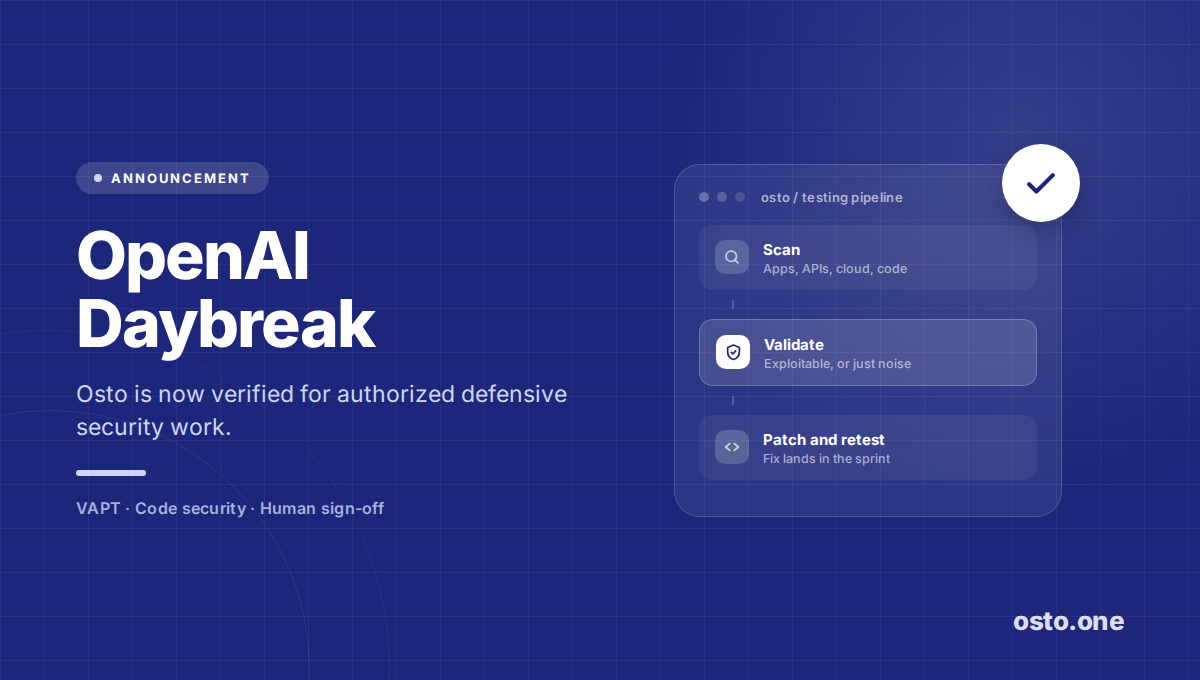
Osto is now verified for OpenAI Daybreak, the access tier built for authorized defensive security work. Here is what it is, what it changes in our testing, and what stays exactly the same.
TL;DR
OpenAI Daybreak is OpenAI’s programme for applying frontier models to defensive cybersecurity: secure code review, threat modelling, exploitability validation, patch verification and dependency risk analysis, built on Codex Security and OpenAI’s frontier cyber models. Access is gated behind identity verification and scoped to systems you own or are explicitly authorized to assess. Osto has completed that verification. It sharpens the testing layer inside our VAPT and code security modules. It does not replace a human tester, and it does not change what we are allowed to touch.
Most things that promise to shorten the distance between finding a vulnerability and shipping the fix turn out to be a better scanner. Occasionally one is something else. OpenAI Daybreak sits in the second category, and it is worth explaining plainly rather than turning it into a logo on a slide.
On this page
What OpenAI Daybreak is
OpenAI Daybreak is not a single model. OpenAI describes it as bringing together frontier cyber models, Codex Security, trusted workflows and ecosystem partnerships, aimed at closing the gap between finding a vulnerability and landing a tested fix rather than generating more unvalidated reports. The workflows it targets are the unglamorous ones that actually decide whether software holds up: secure code review, threat modelling across a whole repository, validating whether a finding is genuinely exploitable, checking that a patch closed the hole it was meant to close, and dependency risk analysis.
Access is tiered. Codex Security covers a broad set of everyday defensive work. Above it sits Daybreak Access, available to verified defenders and pairing more capable, more permissive defensive tooling with stronger verification, scope controls and oversight. Higher still is Daybreak Red, specialised for advanced authorized vulnerability research, exploit validation, penetration testing and red teaming, and gated behind separate approval.
Why the gate exists
A model capable enough to find a real vulnerability in a real codebase is capable enough to be misused. OpenAI’s answer is identity verification, scoped approval and monitoring rather than open access. That is the same trade every serious offensive-security tool has made for twenty years, and it is the right one.
What verified access means, and what it does not
Precision matters here, because this is exactly the kind of announcement that gets inflated in the retelling. Osto has completed OpenAI’s identity verification and holds active OpenAI Daybreak access for authorized defensive work. That is the claim. It is a meaningful one, and it is narrower than some of the language floating around the market.
| What this is | What this is not |
|---|---|
| Verified access to Daybreak capability for authorized defensive security work | Membership of the OpenAI Daybreak Cyber Partner Program, which is a separate track |
| A sharper testing layer inside modules Osto already runs | A new product, a new SKU, or a new line item on your invoice |
| Model-assisted review that a human tester validates before anything reaches you | An autonomous agent that runs unsupervised against customer systems |
| Scoped to assets you own or have explicitly authorized us to assess | Licence to test anything outside an agreed scope |
Where it lands in our testing loop
Osto’s VAPT has always been expert-led penetration testing with an AI scanner underneath it. The scanner categorises by severity, pinpoints affected endpoints and produces remediation and retest reports. OpenAI Daybreak improves the middle of that pipeline, not the ends.
Deeper code review
Reasoning, not pattern matching
Reading across a repository to catch the logic flaws that signature-based tools miss because nothing in the code looks wrong in isolation.
Exploitability validation
Real finding or scanner noise
Pressure-testing a candidate issue in an isolated environment so the report you get is ranked by what an attacker could actually do.
Remediation you can ship
Written for the engineer, not the auditor
Guidance tied to the affected file and endpoint, so the fix lands in the sprint instead of sitting in a PDF for a quarter.
The practical effect is fewer false positives to triage and a shorter gap between a report landing and a patch shipping. For a team of four engineers with no security hire, that gap is the whole problem.
What does not change
Four things stay exactly where they were, and they are the parts that matter most if you are signing the engagement.
| Area | Position |
|---|---|
| Scope | Testing is limited to systems you own or have explicitly authorized us to assess. Written scope first, always. |
| Human sign-off | No finding reaches a customer report without validation by an Osto tester. The model assists, the person decides. |
| Data handling | Customer code and environments stay governed by the same contractual and data protection terms already in place. |
| Pricing | No new SKU, no surcharge. This is a capability improvement inside modules you already have. |
How this fits the rest of the platform
Better testing on its own is a report. It becomes security when the finding, the fix and the evidence live in the same place.
A vulnerability surfaced in code review is the same vulnerability your web and API protection is shielding at the edge, the same one your cloud posture checks may have exposed, and the same one an auditor will ask about when you run a gap analysis for ISO 27001. Because every module is built and run by Osto rather than stitched from third-party defaults, the correlation happens by construction. The evidence is generated by the same platform that fixed the problem.
That is the difference between a purpose-built stack and a shelf of tools that happen to sit next to each other. OpenAI Daybreak makes one layer of ours sharper. The reason it compounds is everything around it.
Book a walkthrough
See it run against your own stack
Expert-led VAPT, code security, cloud posture and compliance automation in one platform. We will walk you through it live, against your scope.
Book a platform walkthroughLive in hours · Scoped and authorized · One platform, everything
Frequently asked questions
What is OpenAI Daybreak?
OpenAI Daybreak is OpenAI’s cybersecurity programme, bringing together frontier cyber models, Codex Security and partner workflows to support defensive work: secure code review, threat modelling, exploitability validation, patch verification, dependency risk analysis and remediation guidance. Access is tiered and gated behind verification, with scope controls and oversight attached.
Is Osto an OpenAI partner?
No. Osto holds verified OpenAI Daybreak access for authorized defensive security work. The OpenAI Daybreak Cyber Partner Program is a separate track with its own approval process, and we are not claiming membership of it. The distinction is worth keeping straight, and we would rather state it than let it blur.
Does this mean an AI runs my penetration test?
No. Osto’s VAPT remains expert-led. Model-assisted review helps surface and validate candidate findings faster, but a human tester validates every finding before it reaches your report. The model changes how quickly a tester gets to the interesting part. It does not replace the tester.
What systems will Osto test using this?
Only the assets inside an agreed, written scope: systems you own or have explicitly authorized us to assess. That constraint is a condition of the access itself, and it matches how Osto has always run penetration testing engagements.
Does this change pricing or my existing plan?
No. There is no new product and no surcharge. This improves the review and validation layer inside the VAPT and code security modules customers already have.
Will this speed up SOC 2 or ISO 27001 readiness?
Indirectly. Faster, cleaner findings mean remediation lands sooner, and readiness depends on controls actually being fixed rather than merely documented. The overall SOC 2 timeline of roughly 115 days end to end does not change, because the three-month evidence-collection window and the external audit are fixed by the framework, not by tooling.