
On 19 May 2026, GitHub confirmed an attacker reached about 3,800 of its internal repositories.
The attacker never touched GitHub’s platform.
They compromised one employee’s laptop through a poisoned VS Code extension, stole the credentials sitting on it, and used them to walk into the repositories as that employee.
For a startup, that path is worth sitting with.
GitHub caught this in a day, has an incident response team, and rotated thousands of credentials overnight.
The mechanism it caught is the same one running on every engineering team’s machines: developer laptops hold production keys, database credentials, and source code, and they run editor extensions with deep local access.
A clean SOC 2 report says nothing about what those extensions can do. This is the gap most startups don’t know they have.
What GitHub confirmed
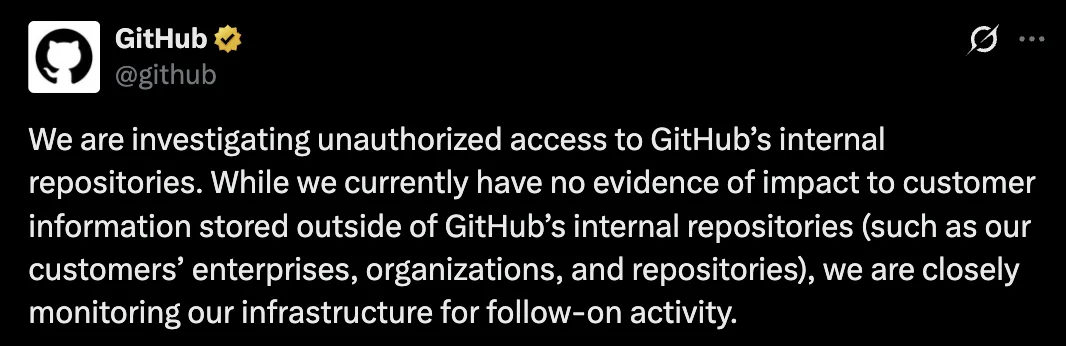
A poisoned Visual Studio Code extension on an employee’s device gave the attacker control of the machine.
GitHub removed the extension, isolated the endpoint, and rotated its highest-impact credentials overnight. It has found no impact on customer or public repositories so far, and the investigation is still open.
The threat group TeamPCP claimed responsibility and listed about 4,000 private repositories for sale on a cybercrime forum at over 50,000 dollars.
They stated this was not a ransom and they had no interest in extorting GitHub. They wanted to sell the data.
GitHub said the 3,800-repository figure is consistent with its own findings.
Why the GitHub breach started in a code editor
The Visual Studio Code Marketplace hosts over 70,000 extensions.
An installed extension can read and write files, run code, reach the network, and read the clipboard. Updates install automatically, and the marketplace does not re-review the code an extension ships in an update after it is first approved.
An attacker publishes something useful, waits for it to earn trust, then pushes a malicious update to everyone who has it. The employee installed a normal tool and the update weaponized it.
Once the payload ran, it had everything the developer had. This family of malware pulls GitHub personal access and OIDC tokens, AWS IAM keys, Kubernetes service-account tokens, HashiCorp Vault tokens, SSH keys, and password-manager databases straight off the disk.
The attacker then used the developer’s GitHub credentials to reach the repositories. No firewall and no login prompt stood in the way, because it was the developer’s own session, run by code the developer never wrote.
Why the GitHub breach fits a six-week pattern
A critical remote code execution flaw in late April. The Grafana token theft on 16 May. Now GitHub. The Grafana breach started with a compromised npm package from the same TeamPCP campaign that hit OpenAI and Mistral AI, and the crew is also behind earlier compromises of the Bitwarden CLI, Aqua Security’s Trivy scanner, and Checkmarx’s KICS. Researchers at SlowMist believe the GitHub credentials may tie back to the same activity.
Attackers have stopped breaking the platforms that host your code. They go after the tools your developers use to write it. The platform stays secure while the perimeter moves onto your team’s laptops.
A poisoned package, a poisoned extension, a stolen token: three entry points, one target, the developer’s toolchain. These are the most capable engineering teams in the world and the attacks landed anyway.
The question is no longer whether your platform is configured correctly. It is what is running inside your engineers’ editors.
What to do this week
An engineer can do most of this in an afternoon. Shrink the surface, cut off what the malware wants, then make sure you would see it next time.
None of this is new advice. The GitHub breach removes the excuse to treat the developer endpoint as someone else’s problem.
The company that runs the world’s largest code platform was reached through one engineer’s editor. You know your platform is locked down.
The question this breach actually asks is whether you know what is running on the machines your engineers open every morning.
The developer machine is now part of your security perimeter. Osto’s Endpoint suite keeps it covered: antimalware and process monitoring that runs on every managed device, file access controls that watch what moves and where, and device management that keeps your fleet visible and audit-ready. One platform, from the laptop to the cloud. Speak to us to learn more about Osto.